
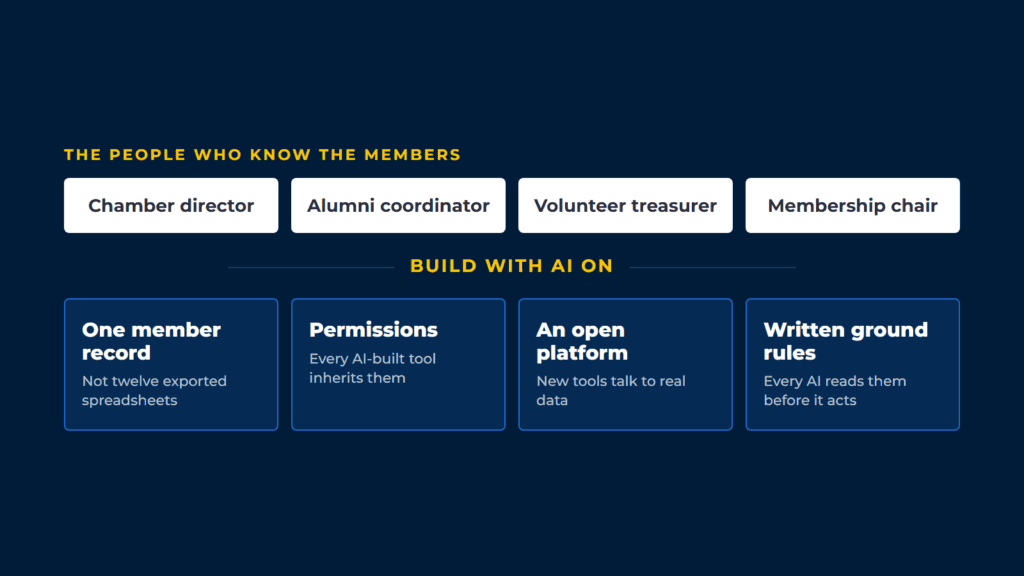
In September David Cohen, the CEO of Techstars, published an essay called The New Shape of Software Engineering. His argument is simple and a little startling: in the near future, most features in most software will not be written by engineers. They will be built by the people closest to the problem, using AI, and the engineers who remain will spend their time on the rails that keep those contributions safe.
Raklet is a Techstars company, so we read anything David writes with some attention. This one landed hard, because we think he is describing startups and has accidentally described associations, chambers of commerce, alumni networks, clubs and nonprofits even better. These are organizations that have always been run by domain experts. What they have never had is engineers. AI is about to change which of those two things matters.
Membership organizations never had a backlog. They had “never.”
David’s most memorable line is that the backlog is dead: the queue of ideas waiting for engineering capacity dissolves when the people with the ideas can build them. At a startup, that queue is a real thing with a ticket number.
At a typical membership organization there is no queue, because there is no one at the other end of it. The executive director of a regional chamber, the volunteer membership chair of a car club, the one-person alumni office: they know exactly what their members need. They know which renewal reminder gets ignored, which event format fills the room, which report the board actually reads. When they wanted a tool that did not exist, the answer was not “next sprint.” It was a spreadsheet, a workaround, or nothing.
That is why we think this shift matters more for our customers than for the startups David is writing to. A startup gets faster. A volunteer-run association gets something it never had at all.
What it looks like in each vertical
The pattern is the same everywhere, but the first things people build will differ by the kind of organization. A few we expect to see soon, if they are not being built already:
- Chambers of commerce. The membership director who fields “who should I talk to about X?” every week builds a referral matcher over the member business directory, instead of answering from memory.
- Alumni networks. The alumni coordinator builds a mentoring match by graduation year, industry and city, the one that was always “too custom” for any off-the-shelf product.
- Professional associations. The education lead turns the continuing-education rules in the bylaws into a credit tracker that flags members who are short before their renewal date.
- Clubs. The volunteer treasurer builds the dues reconciliation they currently do by hand every month, matching bank deposits to member records.
- Nonprofits. The program manager builds a volunteer shift scheduler that understands their actual rules, such as who is certified for which role.
None of these people will call themselves developers. David’s point is that they will not need to. They describe what they want in the language of their domain, and they get back something that runs.
David’s four engineering jobs, translated for a membership organization
Here is where it gets practical. David says the small engineering team that remains owns four things: data, security, infrastructure and integration. Most associations do not have an engineering team at all, so who owns those four things? Our answer: your platform owns most of them, and your staff own the rules.
1. Data: one member record, not twelve spreadsheets
David calls the schema the new architecture. For a membership organization, the schema is the member record: who this person is, what they pay, which events they attended, what they said to staff three years ago. If every volunteer builds a tool on their own export, you end up with a dozen copies of the truth that disagree by Friday. AI-built tools are only as good as the record they read, so the first job is to have one canonical member database that everything else reads from and writes back to.
2. Security: shadow AI arrives before your policy does
David warns that shadow AI shows up by employee twenty. In a membership organization it shows up much earlier, because volunteers bring their own tools. Somebody is already pasting a member list into a chatbot to draft renewal emails. The answer is not a ban, which nobody will follow. It is a permission model that decides what each role can see, built into the platform, so that whatever a volunteer builds inherits it automatically.
3. Infrastructure: the paved road
Platform engineers call it the paved road: make the safe way the easy way and people stop going off-road. For an association, the paved road is a membership platform with an open API, room for custom code and a place to plug new tools in, so that the treasurer’s reconciliation script talks to the real payment records instead of a CSV someone emailed around.
4. Integration: coherence has to come from somewhere
Twenty tools built by twenty volunteers will turn into twenty silos unless they share the same record, the same branding and the same member login. That is the job an association management system was always supposed to do. AI makes it more important, not less, because the number of things that need to fit together is about to multiply.
Your ground rules are now the most valuable thing you write
The part of David’s essay we agree with most is this: the most important artifact is no longer code, it is the ground rules. AI coding tools now read instruction files before they write anything, and those files decide what “done” means and what is off limits.
Membership organizations have an unexpected head start here. You already write rules down. You have bylaws, a data policy, a brand guide, a renewal policy, a code of conduct. Most of it lives in PDFs nobody opens. In an AI-native organization, those documents become the instructions every tool reads before it acts.
We run our own company this way. Raklet is a small team, and much of our marketing and operations work is now done by AI agents working from written rules files. The lesson we keep relearning is that every useful rule was written after something went wrong: an agent that pushed a change to the wrong place, a check that measured the wrong thing. The rules file is where institutional memory goes so that the next person, or the next agent, does not repeat the mistake. That is exactly the problem associations face every time a volunteer board turns over.
A starting version for a membership organization fits on one page:
- Definitions. What counts as a member, a lapsed member, a contact. Which record is the official one.
- Access. Which roles can see contact details, payment history and notes. What never leaves the system.
- Voice. How you write to members, and what you never say (for example, legal or tax advice).
- Money. Who can issue refunds, change dues or create a discount.
- Done. What has to be true before anything a volunteer builds is shown to members.
Write it once, keep it next to your member data, and hand it to every AI tool your team uses. It will do more for your data safety than any training session.
What this means for how you hire and staff
David tells founders to ask their next sales or ops candidate what they have built. We would give the same advice to association boards hiring an executive director or recruiting a membership chair. The most valuable person in a small organization is now the one who understands members deeply and can turn that understanding into a working tool in an afternoon.
It also tilts the field. Large associations carry IT departments and multi-year vendor contracts built for the old constraint. A ten-person chamber with good data and clear rules can now move faster than an organization a hundred times its size. As David puts it, this is the rare shift where being small is the advantage.
Where Raklet fits
We are building Raklet to be the paved road for this: one member record, role-based permissions, an open API and room for your own code, so that what your team builds with AI stays connected and safe. Our own AI features, including an onboarding agent, engagement scoring and an AI page builder, are in development and not yet shipped. If you are thinking about where your member data should live before your volunteers start building on it, see how a membership CRM keeps that record in one place, or read our guide to switching association management software.
Frequently asked questions
Can association staff without coding experience really build software with AI?
Yes, for many internal tools. AI coding assistants let staff describe what they need in plain language and get back a working prototype. The limit is not coding skill but data and rules: a tool is only as reliable as the member record it reads and the permissions it inherits.
What is shadow AI in a membership organization?
Shadow AI is staff or volunteers using AI tools the organization has not approved, for example pasting a member list into a chatbot to draft renewal emails. A ban rarely works. A platform with role-based permissions and one canonical member record gives people a safe place to build instead.
What should go into an AI ground-rules document for an association?
Keep it to one page: what counts as a member and which record is official, which roles can see contact and payment data, how you write to members, who can change money matters such as dues and refunds, and what must be true before anything built with AI is shown to members.
Does Raklet have AI features today?
Raklet’s AI features, including an onboarding agent, engagement scoring and an AI page builder, are in development and not yet shipped. Today Raklet provides the foundation those tools build on: one member record, role-based permissions, an open API and room for custom code.
We would like to hear how this is playing out in your organization. Is anyone on your staff or board building with AI yet?