

Last Updated: May 2026
According to the ASAE Insight Update 2025, 31.9% of association leaders name membership retention as their top challenge. And yet most articles ranking the best association management software were written by the vendors themselves. You deserve a review that actually calls out the tradeoffs.
This guide covers 10 platforms with verified pricing, honest limitations, and an AI maturity table so you can see exactly which “AI features” are shipped versus which ones are just roadmap marketing. Whether you run a 50-member hobbyist club or a 10,000-member professional society, you’ll find a clear answer here.
We looked at pricing transparency, feature depth, membership lifecycle management, event tools, integrations, mobile app quality, support quality, and real AI capabilities. The result is a shortlist you can actually use to make a decision on the best association management software for your organization.
Key Takeaways
- 31.9% of association leaders cite membership retention as their top challenge, making software selection a strategic decision (ASAE Insight Update 2025).
- Pricing spans $0 to $100K+/year. Match your tier to org size before shortlisting.
- Only three platforms have verifiably deployed AI features as of 2026: Nimble AMS, Glue Up, and Fonteva. Most others list AI as “roadmap.”
- Always ask for the all-in cost: implementation, training, migration, and API integrations can equal or exceed the first-year license fee.
- Free and low-cost options exist (Raklet free tier, Tendenci open source) for small organizations not ready to commit to a paid AMS.
What Is Association Management Software?
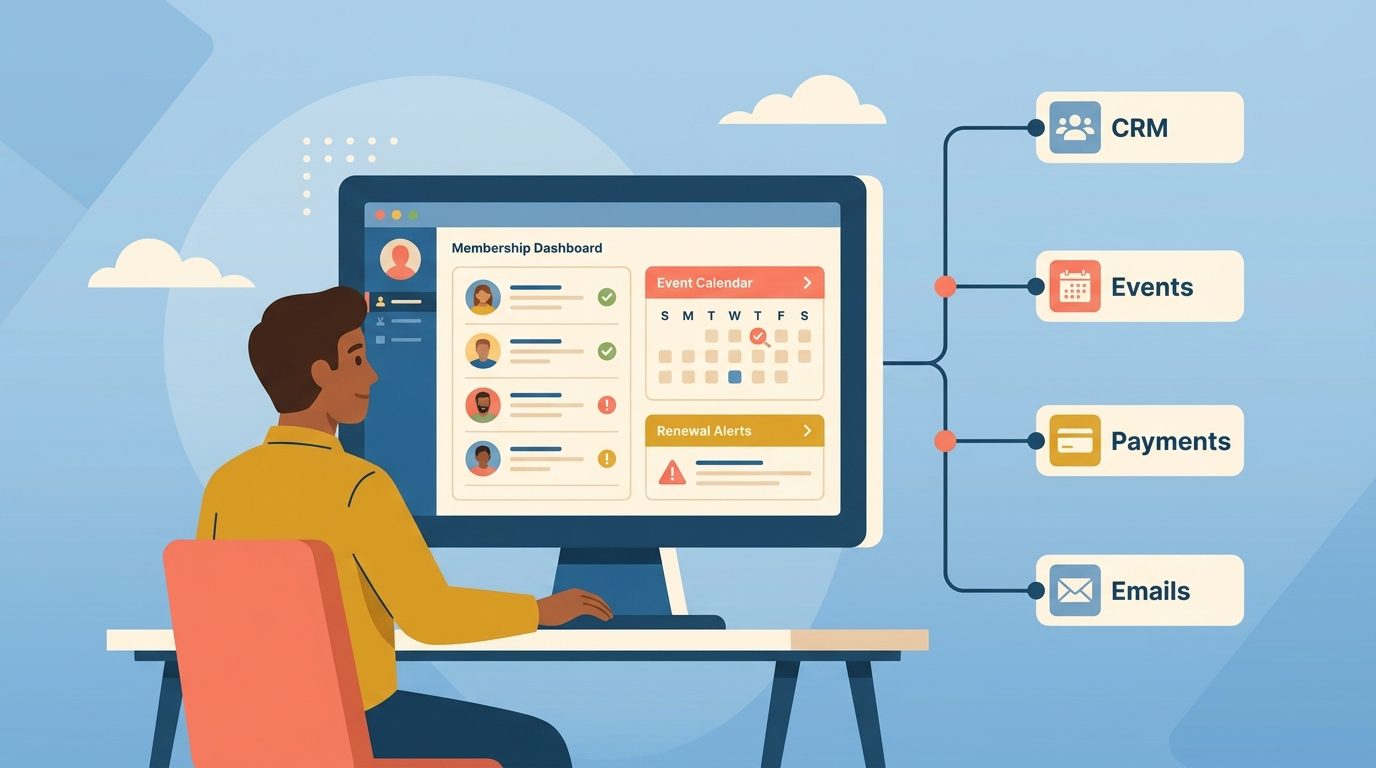
An association management system (AMS) is a platform that centralizes the core operational tasks of running a member organization: dues collection, renewals, event registration, communications, and reporting. According to the ASI iMIS 2025 Membership Performance Benchmark (n=200+), 65% of associations plan to invest in AMS or CRM tools in the next year. The organizations moving earliest on that investment tend to pull ahead on retention and engagement before their peers have even started evaluating vendors.
An AMS is distinct from a general CRM, though the lines blur at the mid-market. The core difference is domain specificity: an AMS is built around the concept of membership tiers, dues cycles, renewals, and member benefits, while a CRM is built around sales pipelines and contact management. Some organizations also work with association management companies that provide outsourced staff alongside the software platform, which is a separate purchasing decision entirely.
AMS vs CRM: What’s the Difference?
A CRM like Salesforce or HubSpot tracks leads, deals, and customer interactions. An AMS tracks members, dues status, event attendance, chapter affiliations, and committee roles. Some AMS platforms (Nimble AMS, Fonteva) are built natively on Salesforce, which gives you CRM power underneath a membership-specific layer. For most associations under 5,000 members, a purpose-built AMS is simpler and faster to implement than a CRM overlay.
The practical test: does your primary workflow involve managing member tiers, renewals, and benefits? Choose an AMS. Do you need complex sales pipeline management or custom reporting across commercial and membership revenue? A CRM-based AMS may be worth the added complexity and cost.
What Features Does an AMS Need to Have?
Core requirements for any AMS evaluation: member database with custom fields, dues and renewal automation, event registration with payment processing, email communications, and a member-facing portal. Beyond the core, the features that separate adequate from excellent are: chapter management, continuing education or certification tracking, reporting dashboards, and mobile access.
The depth of each feature matters as much as its presence. Many platforms list “event management” but support only simple ticketing. Others list “email” but offer no segmentation. Before committing to a demo, map your top three workflows and verify that the platform handles them natively, not through a third-party integration that adds cost and complexity.
How Much Does Association Management Software Cost?

AMS pricing is the industry’s least transparent category. Costs vary from $0 to over $100,000 per year depending on org size and feature requirements. Understanding the tier structure before starting demos will save your team significant time and prevent you from falling in love with a platform that is 5x your budget.
Here is a practical breakdown by organization size:
- Small orgs (under 500 members): $60-$300/month. Platforms in this range include Wild Apricot, Raklet, and MemberPlanet. These cover the essentials with minimal implementation cost and typically offer self-service onboarding.
- Mid-size orgs (500-5,000 members): $300-$1,500/month. MemberClicks, GrowthZone, and Nimble AMS at lower tiers sit here. Expect some implementation support, though often bundled rather than a separate line item.
- Large orgs and enterprise (5,000+ members): $8,000-$30,000+/year. iMIS, Fonteva, and Personify360 operate at this level. Licensing is just the starting point.
Implementation costs are the hidden variable that catches buyers off guard. Depending on tier and data complexity, implementation runs $5,000 to $100,000+ and takes 3 to 9 months. When you see “contact for pricing,” always ask for the all-in cost: implementation, training, data migration, and API integrations. The license fee alone is never the full number.
How We Evaluated These Platforms
Each platform was evaluated across eight criteria: pricing transparency (can you get a real number without a demo?), feature breadth vs. depth, membership lifecycle management, event and chapter tools, integrations (particularly Salesforce and Stripe), mobile app quality, customer support accessibility, and AI features. On AI specifically, we applied a strict standard: “deployed” means production use with verifiable documentation. “Roadmap” means marketing language with no shipped feature confirmed.
We reviewed vendor documentation, G2 and Capterra user reviews, Community Brands industry research, and public pricing pages. Where pricing required a quote, we used reported ranges from credible review sources. Every AI claim in the table below is grounded in product documentation or press release evidence, not vendor assertions during sales calls.
AI Maturity Table: What Each Platform Actually Does
| Platform | AI Status | What It Actually Does |
|---|---|---|
| Nimble AMS | Deployed | Salesforce Einstein-powered member churn prediction; at-risk member scoring in production |
| Glue Up | Deployed | AI Copilot for email drafts and event invitations; predictive renewal modeling |
| Fonteva | Deployed (Salesforce) | Salesforce Agentforce for autonomous renewal processing and record management |
| Raklet | Deployed + In Development | AI onboarding agents automatically match new organizations’ website design at signup; AI page builder and engagement scoring in development |
| iMIS | Roadmap | AI-triggered welcome sequences mentioned in marketing; no production predictive features confirmed as of 2026 |
| GrowthZone | Roadmap | Mentions AI in marketing materials; no shipped features confirmed |
| Wild Apricot | None | No AI features; UI largely static since Personify acquisition in 2020 |
| MemberClicks | None | No AI features identified in research |
Best Association Management Software in 2026: 10 Picks
The 10 platforms below cover the full spectrum from free to enterprise. Each entry uses the same structure: what makes it distinctive, verified pricing, who it’s best for, where it falls short, key features, and AI status.
The AI status classification in each entry below reflects our own research rubric: Deployed = production feature with documented use case; In Development = publicly announced with timeline; Roadmap = mentioned in marketing without confirmed ship date; None = no evidence of AI investment in the product.
1. Raklet: Best All-in-One for Small to Mid-Size Associations
Raklet brings membership management, events, email, and community features into one platform without requiring a Salesforce ecosystem or a dedicated IT team. It’s one of the few AMS platforms with a genuinely usable free tier and a pricing model built around contacts (not “active members”), which means growing organizations can add contact packs instead of being forced into a full tier upgrade.
Pricing: Free tier for up to 100 contacts. Paid plans from $49/month (Essentials, 500 contacts, annual billing). Professional at $99/month (1,000 contacts). Premium at $399/month (10,000 contacts). Add-on contact packs are available at $24/month (annual) per 1,000 contacts for organizations that need to scale without changing tiers.
Best for: Associations that want membership, events, email, and community in one platform. Organizations that don’t need Salesforce integration or advanced chapter management for 50+ chapters.
Not ideal if: Your organization requires advanced chapter management across 50+ chapters, or Salesforce CRM integration is a hard requirement for your data model.
Key features:
- CRM with full contact timeline and custom fields
- Membership database with renewal automation and dues collection
- Event management with QR check-in and ticketing
- Email campaign designer with segmentation
- Branded member portal with community features
- Native refund processing (most competitors require manual workarounds)
- iOS and Android Raklet app, free on all plans; custom-branded mobile app available as an add-on ($299/month, annual billing)
AI: Deployed and in development. AI onboarding agents automatically match a new organization’s website design and import pages at signup, reducing setup time. AI engagement scoring (surfaces at-risk members) and an AI page builder are in active development.
2. Wild Apricot: Best for Very Small Associations with Limited Budget
Wild Apricot was the go-to choice for small clubs and nonprofits for over a decade. Its low entry price and self-service setup still make it accessible for hobbyist clubs and local associations under 500 members. However, the platform’s UI has changed little since Personify acquired it in 2020, and the ceiling for reporting and integrations is low.
Pricing: From $63/month (up to 100 members) to $900/month (unlimited members). No free tier; 30-day trial available.
Best for: Hobbyist clubs, small nonprofits, and local associations under 500 members with simple needs and limited budgets.
Not ideal if: You need robust reporting, API integrations, or plan to grow past 5,000 members. The UI shows its age and the platform’s development pace has slowed noticeably since the Personify acquisition.
Key features: Member database, event registration, basic website builder, email blasts, online payment processing, mobile-responsive member portal.
AI: None. No AI features have been released or announced.
3. MemberClicks: Best for Professional and Trade Associations (Mid-Market)
MemberClicks targets professional societies and trade associations that need committee management, continuing education tracking, and conference tools. It sits comfortably in the mid-market and covers more association-specific depth than Wild Apricot, though it comes with a minimum cost that makes it inappropriate for small organizations.
Pricing: From approximately $4,500/year for small organizations; typical mid-market deployments run $8,000-$15,000/year.
Best for: Professional societies and trade associations with active committees, continuing education or certification requirements, and multi-day conference management needs.
Not ideal if: You are a small club where the minimum cost is prohibitive, or you need advanced Salesforce integration as a core requirement.
Key features: Member database and renewals, committee management, continuing education tracking, conference and event management, job board, email communications, reporting dashboards.
AI: None identified in research.
4. GrowthZone: Best for Chambers of Commerce
GrowthZone was built with chambers of commerce in mind. Its feature set reflects chamber-specific workflows: local business directories, ribbon-cutting event management, advocacy communication tools, and government relations tracking. If you run a chamber, it’s a strong fit. If you don’t, many of its features won’t apply to your use case.
Pricing: Contact for quote; reported ranges run $3,000-$12,000/year depending on membership count and modules.
Best for: Chambers of commerce managing local business directories, community events, advocacy communications, and government relations programs.
Not ideal if: You are not a chamber of commerce. The UI and feature weighting are heavily chamber-optimized, and non-chamber associations often find themselves working around assumptions baked into the platform.
Key features: Business directory management, ribbon-cutting and community event tools, advocacy and government relations module, member communications, billing and dues management.
AI: Roadmap. AI is mentioned in GrowthZone marketing materials, but no shipped production features have been confirmed as of May 2026.
5. Nimble AMS: Best for Large Professional Associations on Salesforce
Nimble AMS is a fully native Salesforce application, which means it inherits the full power of the Salesforce platform: custom reporting, Einstein AI, AppExchange integrations, and a development ecosystem with deep support resources. For large professional societies already invested in Salesforce, it’s the strongest option for AI-powered member intelligence.
Pricing: Contact for quote; enterprise deployments typically run $20,000-$60,000+/year, plus Salesforce licensing, which is a separate cost.
Best for: Large professional societies (1,000+ members) already on the Salesforce ecosystem that want genuine AI-powered churn prediction and at-risk member scoring in production.
Not ideal if: Your organization is not on Salesforce, cannot commit to a 6-12 month implementation window, or cannot absorb the additional cost of Salesforce licensing on top of the AMS fee.
Key features: Full Salesforce-native architecture, Einstein AI churn prediction, member engagement scoring, chapter management, event and certification management, AppExchange integrations.
AI: Deployed. Salesforce Einstein member churn prediction with documented production use. At-risk member scoring is live for clients in production environments.
6. Glue Up: Best for Event-Driven Associations with AI Tools
Glue Up is built around event management first, with membership features layered on top. Its NVIDIA AI partnership has produced the most visible AI toolset of any mid-market AMS: an AI Copilot for email drafts and event invitations, plus predictive renewal modeling that flags members at risk of lapsing before renewal deadlines.
Pricing: From approximately $1,200/year for basic tiers; typical mid-tier deployments run $5,000-$15,000/year.
Best for: Associations where event revenue is the primary income model and AI-assisted communications are a genuine priority. Works well for chapters and regional organizations with frequent event cycles.
Not ideal if: You need complex chapter management or deep Salesforce integration. Membership management depth is shallower than Nimble AMS or MemberClicks for organizations with complex dues structures.
Key features: Event management and ticketing, AI Copilot for communications, predictive renewal modeling, member CRM, chapter management basics, mobile app.
AI: Deployed. NVIDIA AI partnership powers the AI Copilot for email drafts and event invitations. Predictive renewal modeling is in production use.
7. Fonteva: Best for Enterprise Associations on Salesforce (Fully Native)
Fonteva is Salesforce-native at the enterprise end of the market. It was acquired by Togetherwork in 2022, which brought it into a larger portfolio of association-focused software. For organizations that need the full Salesforce ecosystem and are prepared for a significant implementation project, Fonteva delivers the most comprehensive feature set in the market.
Pricing: Contact for quote; all-in costs typically run $40,000-$100,000+/year, including Salesforce licensing.
Best for: Enterprise associations (5,000+ members) that require the complete Salesforce ecosystem, advanced customization, and are prepared for a multi-month implementation project with dedicated internal resources.
Not ideal if: Your annual budget is under $30,000, you are not already a Salesforce customer, or you cannot sustain a 6-18 month implementation timeline before go-live.
Key features: Full Salesforce-native architecture, advanced membership management, certification and credentialing, complex dues and billing, chapter management, AppExchange integrations, Agentforce AI.
AI: Deployed. Salesforce Agentforce for autonomous renewal processing was announced in 2025 and is in production for Fonteva clients.
8. iMIS: Best for Large Healthcare and Science Associations
iMIS has a decades-long track record with healthcare, science, and medical associations that have complex credentialing, certification, and continuing education requirements. Its association-specific depth is hard to match in these verticals. The tradeoff is a steep learning curve and a UI that most users describe as functional rather than modern.
Pricing: Contact for quote; typically $15,000-$50,000/year depending on modules and member count.
Best for: Healthcare, science, and medical associations needing advanced credentialing, certification tracking, complex multi-tier dues structures, and a long reference history in regulated industries.
Not ideal if: You want a modern interface or a short implementation runway. iMIS carries a steep learning curve and most implementations run 6-12+ months.
Key features: Advanced credentialing and certification management, complex dues and billing, chapter and component management, event management, integrations with industry-specific tools, reporting.
AI: Roadmap. AI-triggered welcome sequences are mentioned in iMIS marketing materials; no production predictive features have been confirmed as of May 2026.
9. YourMembership: Best for Associations Moving Away from Legacy Systems
YourMembership is part of the Community Brands portfolio, now operating as Momentive Software (a TA Associates-backed AMS portfolio company, unrelated to SurveyMonkey’s parent Momentive Inc.). It’s positioned as a migration target for mid-size professional associations moving off spreadsheets or older legacy AMS systems. The platform covers the essentials without complexity, which is both its appeal and its ceiling.
Pricing: Contact for quote; typical deployments run $8,000-$25,000/year.
Best for: Mid-size professional associations migrating from spreadsheets or legacy AMS platforms that want a reliable, low-risk transition with solid basic features.
Not ideal if: You want a modern UI, advanced reporting, or AI capabilities. The interface is dated even by the standards of the broader Momentive Software portfolio.
Key features: Member database and renewals, event registration, job board, email communications, member community basics, reporting.
AI: None identified in research.
10. Tendenci: Best Open-Source Option (Self-Hosted)
Tendenci is the only open-source AMS on this list with a meaningful production history. It’s used by progressive organizations, advocacy groups, and associations with in-house technical staff who want no vendor lock-in and full control over their data. The catch is real: if you don’t have developers on staff, the total cost of self-hosted maintenance often exceeds a comparable SaaS AMS subscription.
Pricing: Free (open source under GPL license). Hosting, configuration, and implementation typically run $2,000-$20,000+, depending on technical complexity and whether you use Tendenci’s managed hosting option.
Best for: Associations with in-house technical staff, tight budgets, strong data sovereignty requirements, or organizational philosophy that favors open-source tools. Progressive and advocacy organizations with developer resources.
Not ideal if: You lack in-house development or IT staff. Self-hosted maintenance costs and time investment frequently exceed SaaS AMS pricing for organizations without technical capacity.
Key features: Member management, event registration, job board, news and content management, email, payment processing (via integration), full source code access and customization.
AI: None.
What to Look for When Evaluating Association Management Software

Before shortlisting vendors, take 30 minutes to read a structured evaluation guide on how to choose an AMS. The framework matters as much as the feature comparison. The questions below will save you from the most common AMS purchasing mistakes.
Most AMS evaluations fail at the same point: buyers compare feature lists but skip contract terms and total cost of ownership. Two platforms with identical feature lists can produce a 3x cost difference over a five-year contract once implementation, training, and annual price escalators are factored in. If you are deciding whether to switch, factor these long-term costs into your analysis before committing.
Questions to Ask Every AMS Vendor Before Signing
- What is the all-in cost? Ask for a line-item breakdown: implementation, training, data migration, API integrations, and first-year total. “Starting at” pricing is never the full picture.
- What is the contract length and exit terms? Some AMS contracts auto-renew annually; others lock you in for 3-5 years with significant exit penalties. Understand data portability before you sign.
- How does pricing change as membership grows? Ask for the price at 2x and 3x your current membership count. Tier jumps are often steep and non-negotiable mid-contract.
- What integrations are native vs. third-party connectors? A “Salesforce integration” could mean native sync or a Zapier bridge. The difference affects reliability, data latency, and ongoing cost.
- What does “AI” mean specifically? Ask the vendor to name a shipped feature, describe what data it uses, and provide a production case study from a reference customer. Roadmap items are not AI features.
Red Flags in AMS Sales Processes
- Refuses to provide all-in pricing before a demo. Transparency in pricing signals transparency in the vendor relationship. If they won’t share a realistic number before you invest hours in a demo cycle, that pattern usually continues post-sale.
- Cannot name a reference customer in your association type. A platform strong in healthcare credentialing may be weak in chamber-of-commerce workflows. Ask for a reference customer that matches your organization type specifically.
- AI features are “coming soon” with no production case study. The Community Brands 2024 study found that 65% of Gen Z members use AI tools weekly, versus only 18% of association staff (Community Brands 2024). The member expectation gap is real. Roadmap AI does not close that gap today.
- Contract auto-renews with less than 90-day notice window. A 30-day notice window for a multi-year contract means you can easily miss the cancellation deadline, especially during renewal season.
Free and Open-Source Association Management Software
The MGI 2025 Membership Marketing Benchmarking Report shows that 45% of associations report membership growth, yet only 11% describe their value proposition as “very compelling” to prospective members. For smaller associations still building their value proposition, committing to a $10,000/year AMS before validating the model can be a serious financial risk.
Three genuinely free or low-cost options are worth knowing about before signing any contract.
Raklet’s free tier supports up to 100 contacts with CRM, membership management, event tools, and community features. It’s a real free tier with no time limit, not a trial. Tendenci is the only open-source AMS with a meaningful production history: free to download and deploy, though hosting and configuration costs apply. Wild Apricot offers a 30-day free trial but has no permanent free tier. For organizations under 100 members, Raklet free is the lowest-friction starting point before committing to a paid platform.
The key question for open-source evaluation is honest: does your organization have technical staff who can maintain a self-hosted application? If the answer is no, the “free” platform may cost more in staff time than a $99/month SaaS subscription. Factor that math in before choosing Tendenci over a SaaS option.
Raklet works for associations at every stage: a free plan for organizations under 100 members, paid plans from $49/month for growing associations, and custom pricing for larger bodies. No implementation fee to get started. Explore Raklet’s association management software or compare plans and pricing.
FAQ: Association Management Software
What is the difference between AMS and membership management software?
In practice, the terms are often used interchangeably. “Association management software” typically implies a broader feature set: chapters, committees, advocacy tools, continuing education, and complex dues structures. “Membership management software” often refers to simpler platforms that handle the core member database, renewals, and events without the full association operations layer. The distinction matters most when evaluating mid-market platforms: some cover both use cases; others are optimized for one or the other.
Can a CRM replace association management software?
A general CRM can handle contact management and basic communication, but it won’t replace an AMS for membership-specific workflows without significant customization. Dues cycles, renewal automation, member portal access, chapter hierarchies, and event ticketing require either a purpose-built AMS or a CRM with a specialized AMS layer built on top (like Nimble AMS or Fonteva on Salesforce). Most organizations under 5,000 members find the customization cost of a CRM approach exceeds the cost of a purpose-built AMS.
How long does it take to implement new association management software?
Implementation timelines range from days to over a year, depending on platform tier and data complexity. Self-service platforms like Raklet can be operational in days for small organizations. Mid-market platforms like MemberClicks typically run 1-3 months for data migration and configuration. Enterprise platforms like iMIS, Fonteva, and Nimble AMS commonly require 6-18 months for full implementation. Data migration from a legacy system is usually the longest phase: plan for it explicitly in your project timeline and budget.
What is the ROI of switching to a modern AMS?
The MGI 2025 Membership Marketing Benchmarking Report found that 45% of associations report membership growth, but only 11% describe their value proposition as “very compelling.” Associations that invest in modern systems are better positioned to close that gap: automated renewals, personalized communications, and engagement scoring directly address the retention challenge cited by 31.9% of leaders in the ASAE Insight Update 2025. The ROI shows up in reduced staff hours for manual dues processing, higher renewal rates from automated reminders, and improved member satisfaction from self-service portals.
Is association management software worth it for small associations?
Yes, with the right platform choice. Small associations (under 500 members) don’t need a $15,000/year enterprise AMS. Raklet’s free tier covers up to 100 members with no cost commitment, making it a low-risk starting point. Tendenci provides an open-source alternative for technically capable teams. Wild Apricot’s entry tier starts at $63/month for up to 100 members. The key question is whether the time savings from automated renewals, dues processing, and event registration justify the monthly subscription cost. For most associations managing more than 50 active members, the answer is yes within the first 6 months of use.