
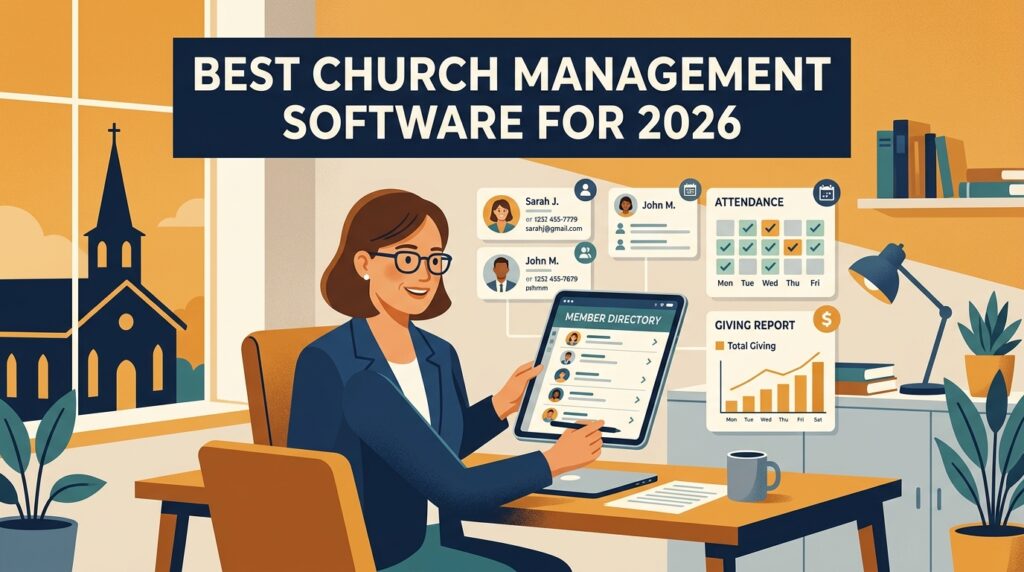
The best church management software for your congregation depends on whether you need to solve a giving problem, a communication problem, or an administration problem. Most churches managing 200 or more members have already tried the spreadsheet approach. It works until it doesn’t, which usually means the moment you need to cross-reference attendance data with a giving campaign, or send a targeted email to members who haven’t shown up in six weeks. According to Pushpay’s State of Technology in the Church report, nearly half of churches are currently managing 5 to 9 separate digital tools. That number climbs every year.
Choosing church management software in 2026 adds a new question to the usual checklist: does the platform have AI built in, or will you need another tool for that? Planning Center now offers natural-language member list building and integrates with Claude and ChatGPT for drafting communications. Tithely has shipped AI-powered giving analytics. Others have none, which is sometimes fine and sometimes a signal worth investigating before you sign a contract.
This guide covers 7 church management software tools in enough depth to actually be useful. Each review includes real pricing, who the tool is genuinely built for, and an honest note on where it falls short. There is also a quick comparison table, a by-church-size recommendation guide, and a FAQ section at the end.
Quick Comparison: 7 Best Church Management Software Tools
| Tool | Best for | Starts at | Free tier | AI features |
|---|---|---|---|---|
| Raklet | Member engagement and communication | $0/mo | Yes | Automated reminders; no generative AI |
| Breeze (Tithely) | All-in-one for small churches | $72/mo | No | AI Insights for giving analytics |
| Planning Center | Mid-to-large churches with service planning needs | Free (People module) | Yes (limited) | AI list building, ChatGPT/Claude integration |
| ChurchTrac | Budget-constrained small churches | $9/mo | No | None |
| ChMeetings | New churches testing digital tools | Free | Yes | Planned for 2026, not yet shipped |
| Realm (ACS) | Mid-to-large churches with financial reporting needs | Quote-based | No | None currently |
| Rock RMS | Large churches with in-house technical capability | Free (open source) | Yes | None natively; community plugins available |
Pricing verified April 2026. Confirm current rates directly with each vendor before purchasing.
7 Best Church Management Software Tools: Full Reviews
Raklet: Best for Member Engagement and Church Membership Management
Raklet is built around the member relationship: who is in your congregation, how engaged they are, and how you communicate with them. The core features cover member database and CRM, digital membership cards, event management, email and SMS communication, and a member directory. Where Raklet stands out is in the depth of its engagement tools: not just tracking whether someone attended, but giving administrators a view into overall member activity and enabling targeted communication based on it.
The platform is a strong fit for churches that prioritize member engagement and communication over giving-first workflows. It works well for faith communities with a strong membership model (think churches that run membership drives, manage tiered participation levels, or serve a mix of in-person and remote members). Raklet’s church management tools also cover church membership management software needs for congregations that want to track member status and renewal alongside event and communication history.
Pricing: Free tier available (CRM, memberships, event management, community features). Essentials plan at $49/month adds the email designer, digital membership cards, and mobile app. Professional at $99/month adds automated reminder emails, integrations, and custom branding. Premium at $399/month adds API access, SSO, and custom domain. See the Raklet pricing page for current details and add-on costs.
Honest limitation: Raklet does not currently offer AI-generated content or AI-powered giving analytics. Automated reminder emails are rule-based, not AI-driven. If your primary need is fund accounting, payroll integration, or sophisticated donation reporting, Breeze or Planning Center with the Giving module will serve you better. Raklet is also not the right fit if your main pain point is worship service planning and volunteer scheduling. Planning Center owns that workflow.
Breeze ChMS (Tithely): Best All-in-One for Small Churches
Breeze has one of the most honest pricing models in this category: $72 per month, flat rate, unlimited users and members. No per-member tiers, no surprise overage fees when your congregation grows. It was acquired by Tithely in 2022, and the two platforms are being merged into a unified Tithely 3.0 experience, which means Breeze users gain access to Tithely’s giving tools, website builder, and church app alongside the existing Breeze ChMS functionality. If you are signing up today rather than migrating from an existing Breeze account, ask the sales team whether you are onboarding to Breeze or directly to Tithely 3.0 (the answer affects which features are available from day one).
The platform covers the full small-church stack: member database, attendance tracking, online giving, groups management, email communication, and contribution reporting. In August 2025, Tithely announced AI Insights, a feature set that analyzes giving patterns and flags members who may be ready to increase generosity, based on their giving history and engagement signals. This is a genuine AI feature, not a rebrand of basic reporting.
Pricing: $72/month flat (all features, unlimited users). Tithely 3.0 bundles vary; confirm current packaging directly with Tithely as the migration from Breeze to the unified platform is still in progress for existing customers. See current pricing at breezechms.com/pricing.
Honest limitation: Worship service planning and volunteer scheduling are basic in Breeze. If your staff runs detailed Sunday morning logistics (song sets, tech team assignments, stage notes), Planning Center’s Services module does this better. Breeze is the stronger choice when administration simplicity and predictable pricing matter more than service-planning depth.
Planning Center: Best Modular System for Mid-to-Large Churches
Planning Center is the platform that church operations staff recommend to each other. Its People module (the contact database) is free. Every other module (Services, Giving, Check-Ins, Groups, Registrations) is an add-on, priced separately starting at $15 per month per module, scaling by usage. This means a small church can start with just People and one or two modules, while a large church can run a full suite.
The Services module is the reason Planning Center is standard in many mid-to-large churches. It handles worship team scheduling, setlist building, volunteer assignments, media organization, and rehearsal notes with a level of detail that no all-in-one platform matches. Planning Center is also the most actively developed platform in this category, shipping updates weekly and adding real AI features in 2026: natural-language list building (“show me all members who attended in the last 30 days but haven’t given this year”) and native integration with Claude and ChatGPT for drafting communications.
Pricing: People module is free. Add-on modules start at $15/month each; costs increase with congregation size. A church using People, Services, Giving, and Check-Ins can expect $60–$200/month depending on scale. Confirm at planningcenter.com/pricing.
Honest limitation: Costs add up quickly when you stack modules. For a church under 150 members that mainly needs a member database and basic communication tools, Planning Center is likely more complexity and cost than needed. It also requires staff time to configure and maintain. It is powerful but not plug-and-play.
ChurchTrac: Best Budget Option for Very Small Churches
ChurchTrac starts at $9 per month for congregations up to 75 members, scaling to $105 per month for unlimited members. The accounting add-on is $15 per month, unusually affordable for churches that need fund accounting without upgrading to an enterprise platform. The platform covers member management, online giving, attendance, groups, child check-in, and basic email and text communication.
It is the right choice for a church that has outgrown a spreadsheet but does not need the full feature set of Breeze or Planning Center. Setup is straightforward, the UI is functional, and users consistently cite the support team as responsive.
Pricing: $9/month (up to 75 members) to $105/month (unlimited). Accounting add-on: $15/month. Messaging add-on: $7/month. Confirm at churchtrac.com/pricing.
Honest limitation: ChurchTrac has no AI features. The platform is actively maintained (accounting enhancements shipped in December 2025), but its development pace is conservative. The interface is functional rather than modern. If your congregation is growing and you anticipate needing more sophisticated communication tools, engagement analytics, or integrations within the next two years, Breeze or Raklet will scale better.
ChMeetings: Best Free Tier for Getting Started
ChMeetings offers a free plan with a meaningful feature set: member database, attendance tracking, event management, group communication, and a member portal. Paid tiers scale to $60/month based on congregation size. The platform is well-regarded for its mobile app and is popular with European congregations and multilingual churches, partly because of its multi-language support.
It is a reasonable starting point for new churches, church plants, or administrators who want to evaluate digital management tools before committing to a paid platform.
Pricing: Free for smaller congregations (member count limit applies). Paid tiers scale to $60/month. Confirm current tier limits at chmeetings.com.
Honest limitation: ChMeetings promised AI features on its 2025 roadmap and did not ship them. The current 2026 roadmap references AI but provides no concrete feature details or timeline. This is not necessarily a reason to avoid the platform (the existing features are solid), but ask the sales team for specifics on when AI capabilities will arrive and what they will do before making a decision based on that roadmap item. Customer support response times are slower than US-headquartered vendors.
Realm by ACS Technologies: Best for Complex Financial Reporting
Realm is designed for mid-to-large congregations that need robust financial tools alongside people management. It covers member profiles, small group management, online giving, attendance tracking, event planning, and fund accounting. Pricing is quote-based, scaled by average weekly attendance, which means it is not typically cost-effective for smaller churches.
The platform’s strength is financial. Fund accounting, contribution statements, budgeting, and reporting are more capable than what most all-in-one platforms offer. It is a common choice for churches that have a dedicated finance team or administrator who needs detailed reporting beyond basic donation tracking.
Pricing: Quote-based, scaled by average weekly attendance. Contact ACS Technologies directly for current pricing.
Honest limitation: Realm has no publicly announced AI features. It is an actively developed cloud platform, but the development focus has been on core functionality rather than AI tooling. For churches under 300 weekly attendees, the cost and complexity are likely not justified. The onboarding process takes time, and the platform requires a steeper learning curve than Breeze or Raklet.
Rock RMS: Best Free Option for Tech-Capable Large Churches
Rock RMS is open-source. The core platform is free, and the code is maintained by the Spark Development Network and a community of church developers. Rock Cloud hosting is available at $50–$200 per month, or self-hosted for organizations with server infrastructure. The feature set is extensive: people management, giving, check-in, workflow automation, event registration, volunteer scheduling, and highly configurable reporting.
Rock is genuinely powerful, but “free and open source” comes with a real cost: technical setup, configuration, and ongoing maintenance require developer involvement. Churches that have adopted Rock successfully typically have a contracted church-tech developer or a staff member with software development experience.
Pricing: Free (self-hosted) plus infrastructure costs, or Rock Cloud at $50–$200/month. Community plugins and integrations may add cost depending on implementation.
Honest limitation: Rock has no built-in AI features. The open-source community has produced various integrations, but native AI tooling does not exist in the current release. More importantly: if your church does not have reliable technical support, Rock will cost more in staff time than a $72/month Breeze subscription. It is the right tool for large churches with the internal capability to use it, and the wrong tool for almost everyone else.
How to Choose the Right Church Management Software
Start With Your Primary Pain Point
Most churches evaluating church management software are trying to solve one specific problem. Identifying that problem first narrows the field significantly.
- Giving campaigns and financial reporting: Tithely or Planning Center with the Giving module. Realm for complex fund accounting at larger congregations.
- Member engagement, communication, and membership tracking: Raklet or Breeze.
- Worship service planning and volunteer scheduling: Planning Center. Its Services module has no real peer.
- Budget under $20/month: ChurchTrac ($9/month for up to 75 members) or ChMeetings (free tier).
- High configurability for a large church with technical staff: Rock RMS.
Watch for Hidden Costs
Monthly base pricing rarely tells the full story. Before signing up, ask each vendor:
- What happens to my price as membership grows past [X] members?
- What are the giving processing fees? (These range from 0% to 3.5% plus per-transaction fees.)
- Are data migration, onboarding, and training included, or billed separately?
- What features require add-on modules vs. being included in the base price?
Run a Trial With Real Scenarios
Request a free trial or demo account and use it to complete the tasks your staff does most often, not the tasks the demo highlights. Create a real member record. Log an actual attendance entry. Send a test email to a segment of members. If the three tasks you do every week feel slow or confusing during the trial, they will feel slower six months into a contract when the novelty wears off.
Church Management Software by Church Size
| Church size | Best fit | Why |
|---|---|---|
| Under 100 members | ChMeetings (free) or ChurchTrac ($9/mo) | Low commitment, easy setup, covers the basics without overcomplicating administration |
| 100–400 members | Breeze ($72/mo flat) or Raklet ($0–$99/mo) | All-in-one pricing with no per-member surprises; Breeze for giving-first, Raklet for engagement-first |
| 400–1,000 members | Planning Center or Raklet | Planning Center for worship and volunteer planning at scale; Raklet for member communication and engagement at scale |
| 1,000+ weekly attendance | Realm or Rock RMS | Enterprise-grade financial reporting (Realm) or full customization for organizations with technical resources (Rock) |
Frequently Asked Questions
How much does church management software typically cost?
Most churches pay between $0 and $120 per month. Free tiers are available from ChMeetings and Rock RMS (self-hosted). Budget all-in-one options start at $9/month (ChurchTrac) or $72/month for a fuller feature set (Breeze). Mid-range platforms like Raklet start free and scale to $49–$99/month for paid features. Planning Center costs vary significantly depending on which modules you use. Realm and Rock Cloud are quote-based and typically suit larger congregations.
Is there genuinely free church management software?
Yes, with caveats. ChMeetings has a free tier for smaller congregations, and the feature set is functional, not a stripped-down trial. Rock RMS is free and open-source, but hosting and technical setup have real costs. Planning Center’s People module is free but covers contact management only; every other function requires a paid add-on. For most churches under 80 members, ChMeetings or ChurchTrac’s entry pricing is the realistic starting point.
What is the best church management software for small churches?
For churches managing under 200 members: Breeze at $72/month is the most complete all-in-one option, with flat-rate pricing and a genuine feature set. ChurchTrac at $9/month is the strongest choice if budget is the primary constraint. Both offer unlimited users at their base price, which matters when multiple staff members or volunteers need access.
Can one platform handle giving, attendance, and member communication?
Yes. Breeze, Raklet, ChMeetings, and ChurchTrac all handle giving, attendance, and communication in a single platform. Planning Center can do all three, but requires separate paid modules for each function. Rock RMS covers all three but requires configuration to set up. The meaningful difference is not feature coverage but how well each platform handles the workflows specific to your church’s size and staff capacity.
How long does it take to switch to church management software?
For a church under 300 members migrating from clean spreadsheet data, most platforms can be set up in one to two days of focused work. Plan for additional time if migrating giving history, creating contribution statements, or importing attendance records from a legacy system. Most platforms offer CSV import. The bottleneck is usually data cleanup before the import, not the import itself.
What to Do Next
The right church management software depends on where your congregation is today and where it is heading in the next three years. If member engagement, communication, and membership tracking are your primary needs, Raklet is worth a closer look: the free tier gives you a real sense of how the platform works before committing to a paid plan. Start at Raklet’s church management overview or review the current pricing options to see which plan fits your congregation’s size.