

Last Updated: April 2026
Only 11% of associations describe their value proposition as “very compelling,” according to the MGI 2025 Membership Marketing Benchmarking Report. The reason is rarely the product. It is that most organizations do not know their members well enough to improve. They do not know which members are at risk before the renewal invoice arrives, which events actually move the needle on retention, or whether their first-year members are engaging at all.
Membership tracking software does not solve that problem automatically. But it gives you the data to see what is actually happening, before a drifting member becomes a lapsed one.
This guide covers the seven metrics that predict retention, the practical steps to set up a tracking system that works, and an honest comparison of six tools. For each tool we document what it actually tracks, not just what the marketing page claims. Most “AI engagement scoring” features on the market today are composites of basic event data with a new label. Where that is the case, we say so.
What Is Membership Tracking Software?
Membership tracking software is a system that centralizes member data, automates renewals, and surfaces engagement signals so you can act on them. At minimum, it stores contact records, membership levels, dues history, and renewal dates in one place. More capable platforms add event attendance records, email engagement data, portal login activity, and reporting dashboards that let you see the health of your membership at a glance.
This is different from a CRM, which is optimized for sales contacts rather than member relationships. It is different from a fundraising platform, which tracks donations rather than renewals. And it is different from a general database, which stores data but gives you no automated workflows around it. Membership tracking software is purpose-built for organizations where dues are a revenue line: associations, nonprofits, professional bodies, clubs, and any other group with a recurring membership model.
Who needs it: any organization managing more than a few hundred members where manual tracking creates operational risk. The moment you miss renewals because someone forgot to check a spreadsheet, you need dedicated software.
The 7 Metrics Every Organization Should Track
Tracking everything is as bad as tracking nothing. These seven metrics are the ones that actually predict retention. Build your reporting dashboard around them and review them monthly, not just at renewal season.
1. Renewal Rate
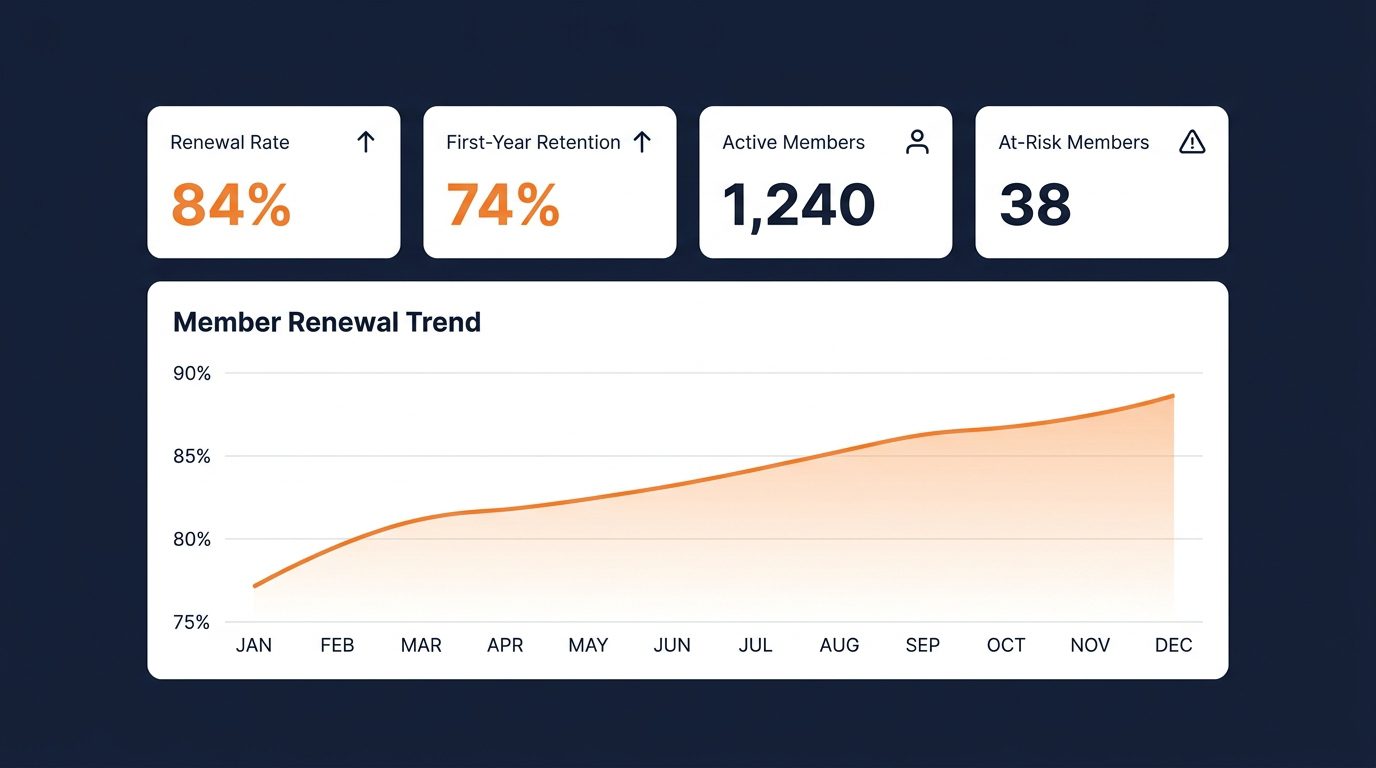
Your renewal rate is the percentage of members who renew their membership each cycle. According to the MGI 2025 Membership Marketing Benchmarking Report, the median renewal rate across associations is 84%. If your renewal rate is below 70%, something structural is wrong, whether that is value delivery, communication timing, or the friction in the renewal process itself.
Track this by membership level and cohort, not just as a single site-wide number. A 90% renewal rate among three-year members can mask a 60% renewal rate among first-year members, which is a very different problem.
2. First-Year Member Engagement
The MGI 2025 data shows that first-year renewal rates run 74 to 75%, roughly 10 points below the median for all members. That gap is the cost of not knowing what new members are doing in their first 90 days.
Track first-year members as their own cohort. Measure portal logins in months 1 through 3, event attendance in the first year, and email open rates on onboarding sequences. If a new member completes no actions in their first 60 days, they are unlikely to renew. Good member engagement strategies for first-year members start with knowing which ones are at risk before the invoice goes out.
3. Engagement Score / Activity Index
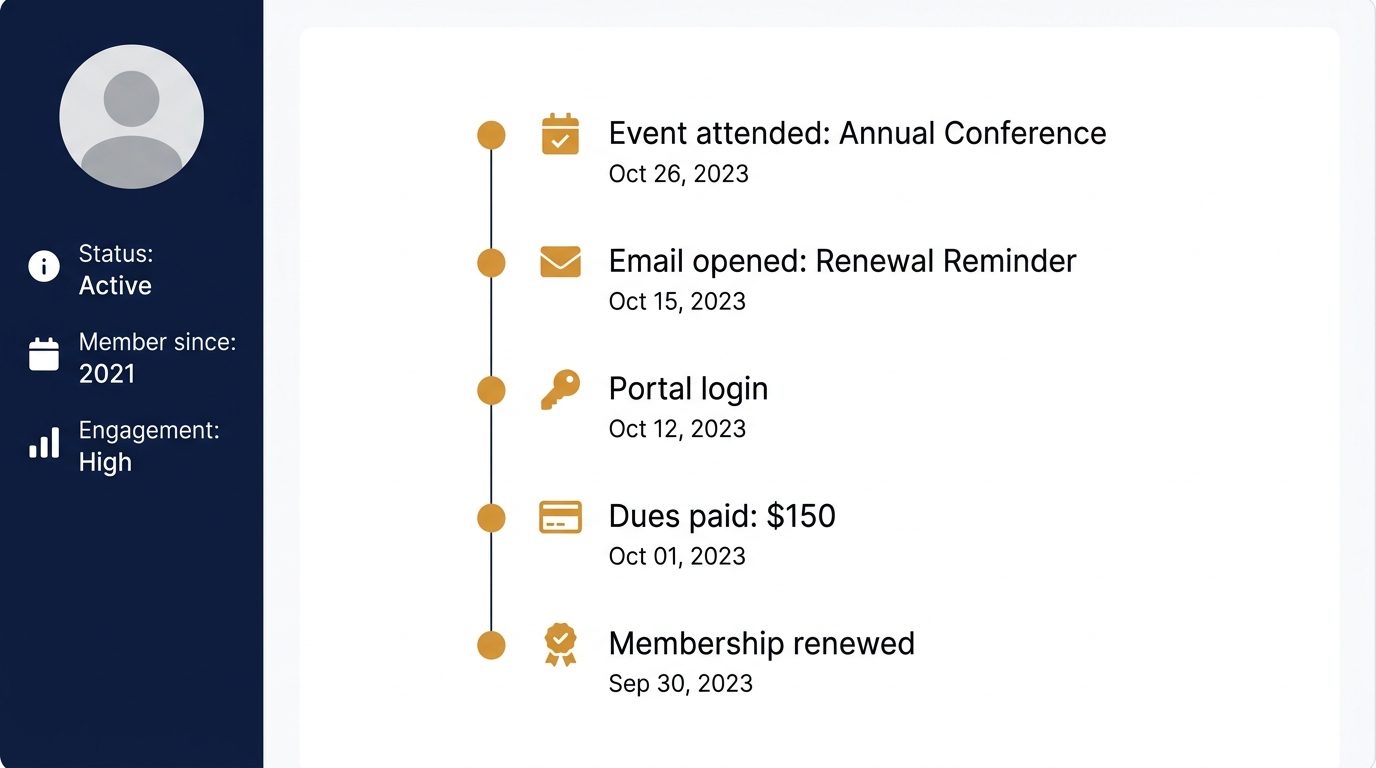
An engagement score is a composite metric that combines multiple activity signals into a single number: events attended, emails opened, portal logins, forum posts, and similar touchpoints. A member with a declining engagement score in months 9 through 11 of their membership year is far more likely to lapse than a member whose score has held steady.
The value of the engagement score is that it gives you a leading indicator. Renewal rate is a lagging metric, you only know you failed after the member left. Engagement score is a leading metric, it tells you who is drifting before the invoice arrives. Only a handful of tools calculate this automatically. Most require you to build it from raw event and email data.
4. Member Growth Rate
Growth rate measures how many new members you are adding relative to your total membership. According to MGI 2025, 45% of associations reported membership growth in 2024. If you are not in that group, the question is whether lapse outpacing acquisition or whether acquisition has simply plateaued.
Formula: (New members in period / Total members at start of period) x 100. Track this monthly and flag when it turns negative for two consecutive months.
5. Lapsed Member Rate
Lapsed members are former members who did not renew. Not all lapsed members are equally recoverable. A member who lapsed 45 days ago and opened two of your last three emails is very different from a member who lapsed 18 months ago and has not engaged with any communication since.
Segment your lapsed pool by recency: lapsed under 90 days (high recovery potential), lapsed 90 days to 1 year (moderate potential with the right offer), lapsed over 1 year (low recovery, do not over-invest). Track the size of each bucket quarterly and measure re-engagement campaign conversion by bucket.
6. Dues Collection Rate
Dues collection rate is the percentage of expected dues revenue you actually collect. The gap between invoiced and collected revenue is often invisible in organizations that rely on manual follow-up. Automated renewal reminders close most of that gap. MGI data shows the average association sends approximately six reminder emails per member per renewal cycle. If you are sending fewer than that, you are leaving money on the table.
Track this as a percentage: (Dues collected / Dues invoiced) x 100. A rate below 90% suggests your collection workflow has a gap, whether that is reminder timing, payment options, or expired card handling.
7. Value Perception Signals
The hardest metric to track is also one of the most important. Value perception is a composite of soft signals: responses to member satisfaction surveys, event attendance trends (are members showing up or just paying?), help desk contact volume, and net promoter score data if you collect it.
The MGI finding that only 11% of associations describe their value proposition as “very compelling” is a value perception problem, not a product problem. Members who do not perceive value do not renew, regardless of how good your software is. Build at least a simple annual member survey into your tracking workflow and trend the results year over year.
When to Switch from a Spreadsheet to Dedicated Software
Spreadsheets work fine for small organizations. If you have fewer than 200 members and a single person handles all membership administration, a well-organized spreadsheet is a perfectly reasonable tool. The upgrade calculus changes when the manual overhead starts producing errors or when the data you need to act on is simply not there.
Five signs you have outgrown a spreadsheet:
- Renewals are being missed because no one checked the date column in time
- Member data is spread across three or more files (contact list, payment tracker, event attendance log)
- You have no visibility into who is engaging and who is not, short of manually reviewing individual records
- Staff are spending more than four hours per week on membership administration tasks that should be automated
- A member calls to complain about a renewal notice they did not receive because their email changed and no one updated it
The upgrade calculus: entry-level membership management software starts at roughly $30 to $60 per month. If you recover even two or three lapsed members per year who would otherwise have left because of a missed renewal notice, at $50 to $200 per member per year in dues, the software pays for itself. The real cost of staying on spreadsheets is not the staff time. It is the members you did not know were leaving.
How to Set Up Your Membership Tracking System
The setup process is the same whether you are moving from a spreadsheet or starting from scratch. Follow these steps in order. Rushing the import step is the most common cause of data quality problems that haunt organizations for years.
Step 1: Define Your Membership Levels and Renewal Logic
Before you touch your software, decide what your membership structure actually is. Annual renewals or rolling (renews on the member’s anniversary date)? Lifetime memberships? Free tiers? Multiple levels with different dues amounts and benefits?
Document this clearly before import. Most software can accommodate any structure, but it needs to be configured correctly from the start. Changing renewal logic after 500 members have been imported creates a data reconciliation problem.
Step 2: Import Your Member Data
Clean before you import. Deduplicate records (the same person in the spreadsheet twice under slightly different names), standardize email formats (remove spaces, fix obvious typos), and decide what to do with lapsed or expired records. Import them as inactive members with their historical data intact, or start fresh? The answer affects your renewal rate calculation for the first year.
When setting up your member tracking system, use the software’s import tool rather than building records manually. Most platforms accept a CSV with a defined field map. Match your spreadsheet columns to the software’s field names before you import, and run a test import with 10 records before committing to the full dataset.
Step 3: Set Up Automated Renewal Reminders
Configure your renewal reminder sequence before any member gets close to their renewal date. The MGI data shows the average association sends approximately six reminder emails per member per renewal cycle, spaced across 60 to 90 days before and after the renewal date.
A working sequence: 60 days before (heads-up), 30 days before (action prompt with payment link), 7 days before (urgency), renewal day (invoice), 7 days after (first lapse notice), 30 days after (recovery offer if you have one). Automate all of these. Do not rely on someone manually sending them.
Step 4: Build Your Engagement Tracking Workflow
Decide what counts as an engagement event in your platform. For most organizations: event registration or attendance, email open or click, portal login, payment or renewal, and any profile update the member initiates. Make sure all of these are being captured and attributed to the correct member record.
If your platform supports an engagement score or activity index, enable it and set a threshold for flagging low-engagement members. For example: any member with zero engagement events in the past 60 days gets flagged for a personal outreach before their renewal date.
Step 5: Create Your Monthly Reporting Dashboard
Set up a recurring monthly review of the seven metrics from the section above. Most membership tracking software has a built-in dashboard; configure it to show renewal rate by cohort, first-year engagement rate, member growth rate, lapsed member count by recency bucket, dues collection rate, and your engagement score distribution. Review this monthly, not quarterly. Problems that look manageable in a quarterly review are often already entrenched by the time you see them.
Membership Tracking Software Comparison (6 Tools)
The right membership tracking program depends on your organization’s size, budget, and how much tracking depth you need. These six tools were selected because they appear most frequently in independent buyer evaluations for association and nonprofit membership management, cover a range of price points from free to enterprise, and each has a meaningfully different tracking approach. Here is an honest breakdown, including real limitations sourced from user reviews and product documentation, not vendor marketing copy.
Quick routing guide: if you are a nonprofit with no budget, start with Zeffy. If you are a small club under 300 members wanting simplicity, Join It covers the basics. If you are a mid-size association wanting communications and tracking in one platform, Raklet or Wild Apricot. If you need full AMS features for a large association, MemberClicks. If your organization runs heavy event programs internationally and wants predictive engagement data, Glue Up.
Raklet
Best for: Mid-size organizations that want communications and tracking integrated in one platform.
Raklet tracks member activity at the record level: each member profile includes an action log and timeline showing recent activity across the platform. Admins can see the last event a member attended, their email open and click rates across every campaign sent through Raklet, the last time they logged into the member portal, and their complete payment and renewal history. Renewal reminders are fully automated. Event attendance is tracked and linked to the member record. All of this feeds into admin-facing reports, and data can be exported via CSV or used to build custom dashboards within the platform. The practical difference from most tools in this list: you can identify a specific at-risk member, see exactly which engagement touchpoints they have and have not taken, and act on that before their renewal date, not after.
Honest limitation: Raklet is newer to the market than some established AMS providers. Organizations with very large memberships (10,000+) or complex chapter structures may find the platform less mature than enterprise-grade alternatives. Pricing starts free for small organizations and scales by feature set.
Wild Apricot
Best for: Established associations already locked into the platform.
Wild Apricot has been around since the early 2000s and is one of the most recognized names in association management. It covers the basics: member database, renewals, event registration, and a member-facing website.
Honest limitation: The product feels dated. The UI has not kept pace with modern software design, and users frequently describe the interface as having a pre-2010 feel. Pricing scales steeply with member count, which catches many growing associations off guard. Users also consistently report that data export and migration out of Wild Apricot is painful, which creates a vendor lock-in dynamic worth factoring into your evaluation. Starts at $63/month.
Join It
Best for: Very small clubs and associations that need the simplest possible subscription tool.
Join It is primarily a subscription management platform. It handles dues collection, basic member profiles, and a recently added member portal. Tracking is limited to a simple activity timeline on each member profile, showing recent activity. There is no engagement scoring, no composite analytics, and no reporting dashboard that surfaces at-risk members.
Honest limitation: Join It is not a tracking tool in any meaningful sense. If you need to identify members at risk before they lapse, it will not give you that signal. It works well for its intended use case: simple subscription management for a small club that does not need analytics depth. Starts at $29/month, no permanent free plan.
MemberClicks
Best for: Mid-to-large associations wanting full AMS features including chapter management and event coordination.
MemberClicks is a mature association management system with a strong feature set: member database, event management, financial reporting, and committee tracking. It includes reporting and analytics that go beyond basic renewal tracking.
Honest limitation: Enterprise pricing and a complex implementation make it overkill for organizations under 1,000 members. Contact for pricing. Expect a multi-month implementation timeline.
Zeffy
Best for: Nonprofits that need a genuinely free platform with no transaction fees.
Zeffy is free for nonprofits with no transaction fees on any payment. It covers donation management, membership dues, event ticketing, and basic member records. For a small nonprofit on a tight budget, it removes the financial barrier entirely.
Honest limitation: Nonprofit-only. No for-profit or association use. Tracking depth is limited to basic member records and payment history. Free, but scoped narrowly. If you need engagement scoring or advanced analytics, you will outgrow it quickly. Looking for more free membership management software options? There are several other tools worth evaluating.
Glue Up
Best for: International associations with heavy event programs and teams that want AI-powered engagement signals.
Glue Up is one of the few platforms where the AI features are genuinely useful rather than marketing language. Its engagement prediction model is built on actual member activity data (events, communications, portal behavior) and surfaces at-risk members before they lapse. For organizations that run frequent in-person and virtual events, the event management and attendance tracking integration is strong.
Honest limitation: Premium pricing, typically $1,000 or more per year. The AI engagement features require a reasonably large member base and consistent data inputs to be meaningful. Worth it for the right organization, overkill for smaller ones.
Frequently Asked Questions
What is the best free membership tracking software?
Zeffy is the best option for nonprofits, with no transaction fees and no platform cost. Raklet also offers a free plan for smaller organizations. For a fuller comparison of free options, see our guide to free membership management software.
What is a good membership retention rate?
According to the MGI 2025 Membership Marketing Benchmarking Report, the median renewal rate across associations is 84%. First-year members renew at a lower rate, typically 74 to 75%. If your renewal rate is below 70%, that signals a structural problem worth investigating rather than a normal variance.
How do I track member engagement?
Engagement tracking combines multiple signals into a composite score: event attendance, email opens and clicks, portal logins, and any other platform activity you define. Good membership tracking software captures all of these automatically and links them to the member record. The goal is to identify low-engagement members before their renewal date, not after they lapse.
When should I switch from a spreadsheet to membership software?
The practical threshold is around 200 to 300 members. Before that, a spreadsheet managed by one person is usually sufficient. Past that threshold, the combination of manual renewal tracking, disconnected data files, and no engagement visibility creates real operational risk. The five signs listed earlier in this article are the clearest signals that you have crossed that line.
Can I track membership in Excel?
Yes, below 200 members, Excel or Google Sheets can work. You will need separate tabs for member records, dues tracking, and event attendance, and a manual process for sending renewal reminders. The main gap is engagement visibility: spreadsheets do not tell you who is disengaging before they lapse. That is where dedicated software earns its cost.
Choosing the Right Membership Tracking Software
The seven metrics above are only useful if you have a system that captures and surfaces them reliably. Renewal rate, first-year engagement, engagement score, growth rate, lapsed member segmentation, dues collection rate, and value perception signals: these are the inputs that let you act on member behavior before it becomes member churn. The right membership tracking software gives you those inputs automatically, so your team spends time on the decisions, not on building the reports.
If you are evaluating options, Raklet’s membership management software covers the full tracking stack: member timelines, engagement data, automated renewals, and reporting, with a free plan to start. The platform is built around the idea that better data leads to better member outcomes, not just more features.