

Last Updated: April 2026
A thank you letter for donations is the single most consequential piece of communication your nonprofit sends. According to the Fundraising Effectiveness Project’s 2024 Fundraising Report, the average first-time donor retention rate is 19.4%. For repeat donors, it climbs to 69.2%. That gap represents roughly $4 in future revenue for every dollar spent on donor stewardship. Research by Adrian Sargeant found that 13% of donors who lapsed had never received a thank-you for their gift, a fixable failure with a clear remedy.
This guide covers what nonprofit teams need most: the IRS written acknowledgment rules that determine legal compliance, the anatomy of an effective thank-you letter, and nine ready-to-use templates for every common donor scenario. The IRS requirements below apply to US federal tax law. Donors should consult their own tax advisor for any state-specific rules that may apply.

Why Donor Thank-You Letters Drive Retention
Most nonprofit fundraising literature focuses on acquisition: how to attract new donors, run a campaign, optimize your donation page. Far less attention goes to what happens in the 48 hours after a gift arrives. That window is where donor retention is won or lost.
The numbers from Giving USA 2025 show that US charitable giving reached $592.5 billion in 2024, with individuals accounting for $392.45 billion of that total. Most of that giving goes to organizations the donor has already supported. Retention, not acquisition, is what sustains a nonprofit’s fundraising base over time.
A thank-you letter does three things a form receipt cannot: it validates the donor’s decision (“your instinct to give to this cause was right”), it connects the gift to a concrete outcome (“your $75 provides three meals”), and it establishes a personal relationship before the next ask. A letter that treats the donor as a transaction (order confirmed, amount recorded, have a nice day) eliminates all three.
“Personal” does not mean a handwritten note to every donor. It means the letter includes the donor’s name (not “Dear Friend”), the specific amount and campaign, and a sentence that could not have been written for anyone else. Merge-field personalization at scale is acceptable if the template is strong enough that the personal details feel genuine rather than inserted.
IRS Requirements for Donation Thank-You Letters

Most nonprofit thank-you letter guides skip this section entirely. None of the top five search results for this topic cover the federal rules in any meaningful depth. That omission is a practical problem: a thank-you letter that lacks the required IRS language fails as both a stewardship tool and a tax document.
Note: The requirements below reflect US federal tax law. Consult a tax professional or your state’s charitable registration office for any state-level obligations.
The $250 Threshold: When a Written Acknowledgment Is Legally Required
Under IRS rules for charitable contribution written acknowledgments, a donor cannot claim a charitable deduction for any single cash contribution of $250 or more without a written acknowledgment from the nonprofit. No written acknowledgment, no deduction. Providing one promptly is both best practice and a direct service to your donors.
For gifts under $250, a written acknowledgment is best practice but not a legal requirement. The donor can use a canceled check, bank record, or credit card statement as documentation for tax purposes. Sending a thank-you letter anyway is still the right thing to do, but it does not need to include formal acknowledgment language for smaller gifts.
One important nuance: the $250 threshold applies per contribution, not per donor. A donor who gives $100 three times in a year is not legally entitled to a single $300 acknowledgment; each gift is assessed individually. However, for recurring donors, an annual consolidated acknowledgment is a common and accepted practice if each individual gift remains under the threshold.
What Must Appear in Your Acknowledgment Letter
For any contribution of $250 or more, the IRS requires the written acknowledgment to include all of the following:
- The organization’s full legal name
- The date and amount of the contribution (for cash gifts)
- A description of the donated property (for non-cash gifts), without assigning a value
- A statement confirming whether any goods or services were provided in exchange for the gift
- If goods or services were provided: a good-faith estimate of their value
The letter does not need to be formatted as a separate legal document. A well-written thank-you letter that includes all five elements above serves as both a donor stewardship communication and a compliant written acknowledgment. Templates 2, 4, and 9 below include this language built in.
Quid-Pro-Quo Disclosure (Corporate Sponsors and Event Donors)
A quid-pro-quo contribution is one where the donor receives something of value in return for their gift: a gala dinner, priority seating, a goodie bag, logo placement, or event tickets. When the total payment exceeds $75 and the donor received goods or services in exchange, the nonprofit must provide written disclosure of the non-deductible portion.
The disclosure statement must inform the donor that the deductible portion of their contribution equals the total payment minus the fair market value of the goods or services received. IRS Publication 1771 sets out the requirements in full. The penalty for failing to provide this disclosure is $10 per contribution, up to $5,000 per fundraising event.
Templates 8 and 9 below include quid-pro-quo disclosure language with bracketed fields for the non-deductible amount.
Can a Thank-You Email Count as a Tax Receipt?
Yes. The IRS does not require a physical paper document. An email that includes all required acknowledgment elements (the five items listed above) and is received by the donor before they file their tax return satisfies the written acknowledgment requirement.
The timing rule matters: the acknowledgment must be provided by the earlier of (a) the date the donor files their return or (b) the original due date of their return (typically April 15 for individual filers). In practice, sending the acknowledgment within 48 hours of the gift eliminates any timing risk.
The Anatomy of an Effective Donation Thank-You Letter
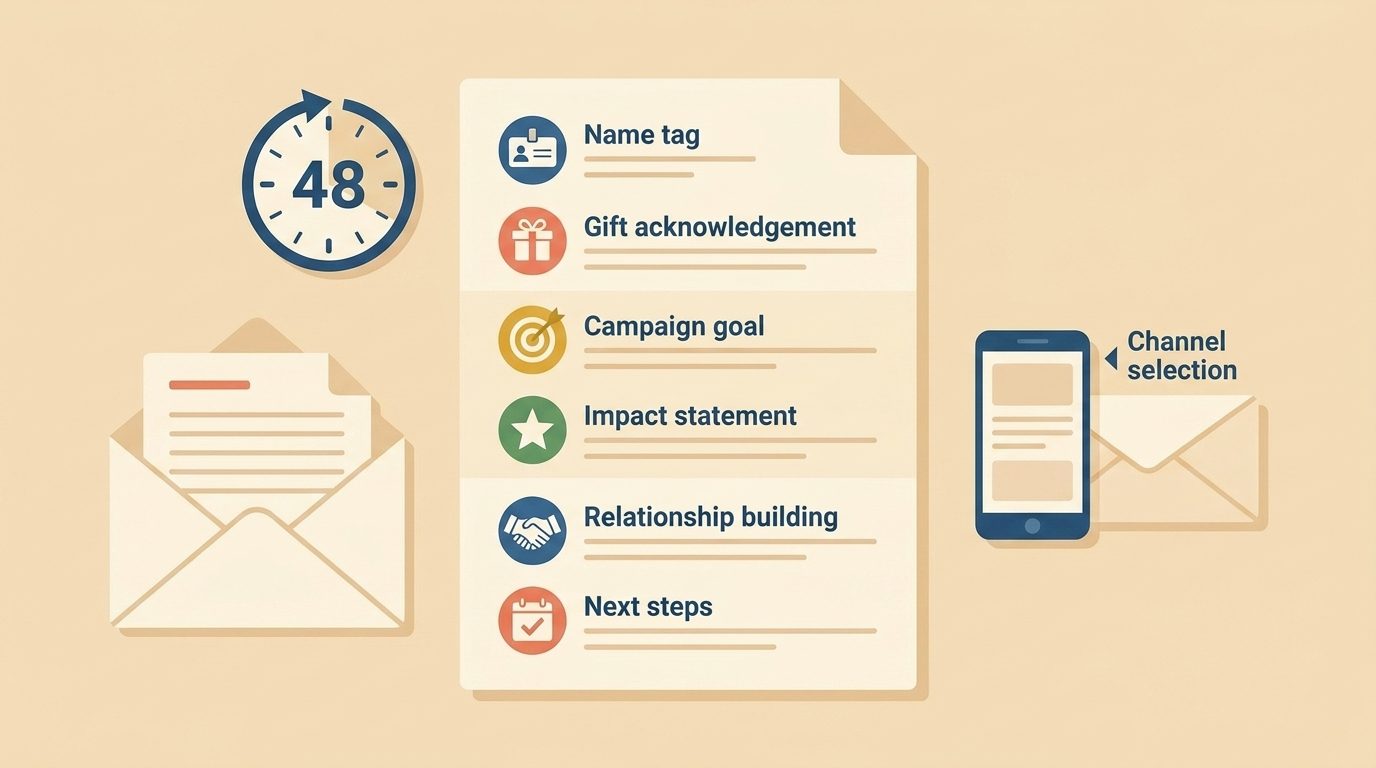
Knowing what is legally required is the floor. A thank you letter for donors requires attention to timing, channel, and content: three decisions that most generic advice collapses into one.
Timing: The 48-Hour Benchmark
The sector-standard guidance from the Association of Fundraising Professionals is to send a thank-you acknowledgment within 48 hours of receiving a gift. For new or one-time online donations processed through your donation page, an automated acknowledgment can go out immediately. Follow up with a personal letter within 48 hours for gifts above a threshold your organization sets. For recurring monthly donors, this rule applies to the initial gift only; ongoing payments use the annual recap approach in Template 3.
For major donors ($1,000 or more), the bar is higher: acknowledgment within 24 hours is standard, and the communication should come from the executive director or board chair, not the development associate. For recurring or monthly donors, do not send a thank-you letter after every automated payment, which quickly becomes noise. Instead, send one meaningful annual recap letter that summarizes the year’s giving and its impact (see Template 3).
Channel: Email vs. Postal Letter
| Donor scenario | Recommended channel |
|---|---|
| First-time online donor | Email (speed matters most for first-time retention) |
| Major donor ($1,000+) | Signed physical letter + email confirmation |
| Recurring / annual fund donor | Annual impact recap by email or postal letter |
| Memorial donation (from the donor) | Physical letter preferred (grief context makes email feel transactional) |
| Memorial notification to family | Physical letter only |
| Corporate sponsor | Formal physical letter on org letterhead |
| Post-event donor | Email within 48 hours; physical follow-up for major event gifts |
What to Include: The Core Elements
Regardless of channel or donor type, every effective donor thank-you letter includes:
- The donor’s full name (not “Dear Friend” or “Dear Supporter”)
- The specific gift amount and date
- The campaign or purpose the gift supports
- A concrete impact statement: what the gift makes possible, in specific terms
- IRS acknowledgment language, for gifts of $250 or more
- A personal sign-off: the sender’s name and title, not “The Team”
- A next touchpoint: an upcoming event, impact report, or initiative (not another ask)
One element that appears in most generic advice but rarely in practice: the absence of a solicitation. A thank-you letter that pivots to another ask in the final paragraph undermines the stewardship it is trying to build. The next ask belongs in a separate communication.
9 Donation Thank-You Letter Templates for Every Donor Scenario

Each template below includes a full letter or email body, IRS compliance notes where applicable, and brief tone guidance. Replace all bracketed fields before sending. These are starting points. The more specific you make the impact language, the more effective each letter will be.
Note: This article covers thank-you letters for monetary and in-kind donations. For volunteer appreciation letters, see our complete guide on writing a thank you letter for volunteering.
Template 1: First-Time Donor (Email)
Tone note: Emphasize mission validation over efficiency. The donor made a values decision; confirm it was right. No second ask, no mention of other programs.
IRS note: Add the acknowledgment paragraph below if the gift is $250 or more.
Subject: Thank you, [First Name]: here’s what your gift makes possible
Dear [First Name],
Thank you for your generous gift of $[Amount] to [Organization Name] on [Date]. It is the first gift we have received from you, and we are genuinely glad you are here.
Your support goes directly toward [specific program or purpose]. For example, [one concrete, specific impact sentence, e.g., “a gift of this size covers three weeks of after-school tutoring for one student”]. We will send you a brief update in [month] showing how this year’s gifts from supporters like you have moved that work forward.
[IRS acknowledgment, if gift >= $250: “In accordance with IRS requirements, please note that [Organization Legal Name] provided no goods or services in exchange for this contribution. This letter serves as your written acknowledgment for tax purposes.”]
Thank you again. We hope this is the beginning of a long relationship.
With gratitude,
[Your Name]
[Title], [Organization Name]
Template 2: Formal Donation Thank-You Letter (General / One-Time)
Tone note: Suitable for any one-time donor regardless of amount. Formal enough for postal delivery, personal enough to avoid feeling like a form letter. IRS acknowledgment language is built in for gifts of $250 or more.
[Date]
[Donor Full Name]
[Donor Address]Dear [Donor Full Name],
On behalf of [Organization Legal Name], I want to thank you sincerely for your contribution of $[Amount] received on [Date]. Your support is a meaningful part of what makes our work possible.
[Organization Name] works to [mission statement in one sentence]. Your gift will help us [specific impact, e.g., “provide emergency food assistance to families in [County] this winter”]. We do not take that trust lightly.
Please retain this letter as your written acknowledgment for tax purposes. [Organization Legal Name] is a 501(c)(3) organization (EIN: [XX-XXXXXXX]). No goods or services were provided in exchange for your contribution.
If you have questions about your gift or our work, please reach out to us at [phone number or your organization’s contact page URL]. We would welcome the chance to speak with you.
With sincere gratitude,
[Executive Director Name]
Executive Director, [Organization Name]P.S. We hope to see you at [upcoming event name] on [date]. Your presence matters as much as your gift.
Template 3: Recurring / Monthly Donor (Annual Impact Recap)
Tone note: This letter goes out once per year, not after each monthly payment. Milestone recognition, not transaction confirmation. Focus on cumulative impact over the year.
IRS note: If any single monthly payment was $250 or more, include the standard acknowledgment language. If individual payments were each under $250, the annual recap is stewardship; a formal acknowledgment is not required in this case, though it is still good practice.
Dear [First Name],
Over the past year, your monthly gift of $[Monthly Amount] added up to $[Total Annual Amount] in support of [Organization Name]. That is not a small thing. Your consistent support means our team can plan programs, not just run them when funds happen to arrive.
Here is a brief look at what [Year] made possible:
[3-4 bullet points of annual impact metrics, e.g.:
• [X] meals provided through [Program]
• [Y] families served in [City/Region]
• [Z]% increase in [measurable outcome]]You were part of all of it. Thank you for making a commitment, not just a contribution.
We look forward to another year of this work together. If you ever want to connect and hear more about where we are headed, please reach out.
[If any single gift >= $250: “For your records: [Organization Legal Name] (EIN: [XX-XXXXXXX]) is a 501(c)(3) organization. No goods or services were provided in exchange for your contributions. This letter summarizes your giving for the calendar year ending [December 31, Year].”]
With deep appreciation,
[Name], [Title]
Template 4: Major Donor ($1,000 or More)
Tone note: Signed personally by the executive director or board chair. Highly specific impact language: name a program, a person, or a measurable metric. Physical letter preferred; email confirmation acceptable as a supplement. Sent within 24 hours.
[Date]
[Donor Full Name]
[Donor Address]Dear [Donor Full Name],
I am writing personally to thank you for your extraordinary gift of $[Amount] to [Organization Name]. A contribution at this level makes a genuine difference in what we can accomplish, and I want you to understand exactly how.
[Organization Name] is currently [specific initiative, e.g., “expanding our legal aid clinic to serve a second location in [Neighborhood] by Q3 of this year”]. Your gift will fund [specific, named component, e.g., “the first three months of staffing for that second site”]. That is a direct, traceable connection between your generosity and a tangible outcome.
In accordance with IRS requirements: [Organization Legal Name] is a 501(c)(3) organization (EIN: [XX-XXXXXXX]). No goods or services were provided in exchange for your contribution of $[Amount] on [Date]. This letter serves as your written acknowledgment for federal tax purposes.
I would welcome the chance to speak with you in person or by phone. Please feel free to contact me directly at [your direct phone or office number].
With genuine gratitude,
[Executive Director or Board Chair Name]
[Title], [Organization Name]P.S. We are hosting a small appreciation dinner for our major donors on [Date]. I hope you will join us; details to follow.
Template 5: In-Kind Donation
Tone note: Do not assign a dollar value to the donated items. Describe how the items were or will be used. The IRS prohibits nonprofits from valuing non-cash gifts for donor tax purposes. The donor obtains their own independent appraisal if the items are valued at $500 or more (IRS Form 8283).
Dear [Donor Name],
Thank you for your generous in-kind donation to [Organization Name]. On [Date], we received [description of donated items, e.g., “approximately 50 boxes of non-perishable food items, including canned goods, pasta, and rice”] from you.
These items are being used to [specific use, e.g., “stock our emergency pantry at [Location], which serves an average of [X] families each week”]. Your donation fills a direct need in our community, and we are grateful.
Please retain this letter for your records. As required by IRS regulations, [Organization Legal Name] (EIN: [XX-XXXXXXX]) has not assigned a dollar value to your donated items. If you plan to claim a charitable deduction of $500 or more for this contribution, you will need to obtain an independent appraisal and complete IRS Form 8283. No goods or services were provided by [Organization Name] in exchange for this donation.
Thank you again for your thoughtfulness.
[Name], [Title]
Template 6: Memorial Donation (Donor-Facing)
Tone note: This letter goes to the person who made the donation in memory of someone. Lead with condolences, not organizational gratitude. The donor gave to honor a person, not to support your mission statement. Keep it brief. No second ask, no upcoming event mentions.
Dear [Donor Name],
We were deeply touched to receive your gift of $[Amount] in memory of [Honoree Name]. Please accept our sincere condolences for your loss.
Honoring [Honoree Name] through a gift to [Organization Name] is a meaningful tribute, and one that will do genuine good. Your donation will support [mission or program, briefly, in one sentence].
[If gift >= $250: “For your records: [Organization Legal Name] (EIN: [XX-XXXXXXX]) is a 501(c)(3) tax-exempt organization. No goods or services were provided in exchange for your contribution. This letter serves as your written acknowledgment for tax purposes.”]
With heartfelt gratitude and sympathy,
[Name], [Title]
Template 7: Family Notification Letter for a Memorial Gift
Tone note: This is a separate letter sent to the bereaved family to inform them that a gift was made in honor of their loved one. Do not include the donation amount. Families should not feel any obligation, financial or otherwise, in response to this letter. Focus on the honor, not the transaction. Send within 48 hours of receiving the donation.
[Date]
[Family Member Name]
[Family Address]Dear [Family Member Name] and family,
We wanted you to know that [Donor Name] has made a gift to [Organization Name] in memory of [Honoree Name].
[Organization Name] [brief mission description, e.g., “provides free legal services to low-income residents in [City]”]. The generosity shown in [Honoree Name]’s name reflects a care for others that your family clearly shared with [him/her/them].
We offer our sincere condolences and our gratitude for the honor of being remembered in this way.
Sincerely,
[Name], [Title]
[Organization Name]
Template 8: Post-Fundraising Event Donor
Tone note: References the specific event. Includes event-level impact metrics alongside the individual gift. Invitation to the next event or campaign as a closing touchpoint, not another direct ask. If the donor received anything of value at the event (dinner, entertainment, premium items), include the quid-pro-quo disclosure.
Dear [First Name],
Thank you for joining us at [Event Name] on [Date] and for your generous gift of $[Amount]. We are so glad you were there.
Together, this year’s attendees raised $[Total Raised] in a single evening, enough to [specific impact, e.g., “fund our summer scholarship program for [X] students”]. Your contribution was part of that collective achievement.
[If donor received goods or services at the event: “Please note for your tax records: in exchange for your contribution of $[Total Payment], [Organization Name] provided [description of benefit, e.g., ‘dinner and entertainment’] with an estimated fair market value of $[FMV]. The deductible portion of your gift is $[Total Payment minus FMV], as required by IRS quid-pro-quo disclosure rules. [Organization Legal Name] is a 501(c)(3) organization (EIN: [XX-XXXXXXX]).”]
[If no goods or services provided: “No goods or services were provided in exchange for your contribution. This letter serves as your written acknowledgment for tax purposes.”]
We hope to see you at our next event: we will be hosting [upcoming event or campaign name] in [Month]. Details to follow. In the meantime, we hope you will explore some of the virtual fundraising events our community runs throughout the year.
With thanks,
[Name], [Title]
Template 9: Corporate Sponsor
Tone note: Formal letterhead format. Acknowledges the partnership framing most corporate sponsors prefer. Includes quid-pro-quo disclosure if the sponsor received anything of value (signage, logo placement, tickets, speaking opportunities). Reference to IRS Publication 1771 in a footnote for compliance completeness. For more on structuring corporate relationships, see our guide on corporate sponsorship for nonprofits.
[Date]
[Contact Name]
[Title]
[Company Name]
[Address]Dear [Contact Name],
On behalf of [Organization Name], I want to extend our sincere gratitude to [Company Name] for your sponsorship of $[Amount] in support of [Event/Program Name] on [Date].
Your partnership made it possible for us to [specific impact, e.g., “provide free admission to 200 community members who would otherwise not have been able to attend”]. We are proud to have [Company Name] alongside us in this work.
For your records: [Organization Legal Name] is a 501(c)(3) organization (EIN: [XX-XXXXXXX]).
[If sponsor received anything of value: “In accordance with IRS quid-pro-quo contribution rules (see IRS Publication 1771), please note that [Company Name] received [description of benefits, e.g., logo placement on all event materials, two sponsored tables seating ten guests, and one speaking opportunity] in exchange for this contribution. The estimated fair market value of these benefits is $[FMV]. The deductible portion of your contribution is $[Total minus FMV].”]
[If no benefits received: “No goods or services were provided in exchange for this contribution. This letter serves as your written acknowledgment for federal tax purposes.”]
We look forward to sharing the full impact report for [Event/Program] in [Month]. Thank you for investing in [mission area, e.g., “workforce development in our community”].
Respectfully,
[Executive Director or Development Director Name]
[Title], [Organization Name]
[Phone number]Reference: IRS Publication 1771, Charitable Contributions, Substantiation and Disclosure Requirements (irs.gov/pub/irs-pdf/p1771.pdf)
How Raklet Helps Nonprofits Manage Donor Thank-You Letters
Sending a well-crafted, compliant thank you letter for donations is straightforward in principle and time-consuming in practice, especially as your donor base grows. Raklet’s nonprofit management platform connects your donor records, gift history, and communication workflows so your team can trigger personalized acknowledgments automatically, without losing the personal tone that drives retention. Explore our online fundraising tools guide or learn more about Raklet for nonprofits to see how it fits your organization’s workflow.
Frequently Asked Questions
Is a thank-you letter required for every donation?
No. The IRS requires a written acknowledgment only for single contributions of $250 or more when the donor intends to claim a charitable deduction. For gifts under that threshold, a bank record or credit card statement is sufficient for tax purposes. That said, sending a thank you letter for donations with every gift, regardless of amount, is among the most evidence-based practices in donor retention.
Can my thank-you email double as a tax receipt?
Yes, if it includes all required IRS elements: the organization’s legal name, the date and amount of the contribution, and a statement confirming whether any goods or services were provided in exchange. The IRS does not require physical paper. The acknowledgment must reach the donor before they file their return, so sending within 48 hours of the gift eliminates any timing risk.
How soon should I send a donation thank-you letter?
Within 48 hours for most donors. Within 24 hours for major donors ($1,000 or more), where the acknowledgment should come from the executive director or board chair. For recurring monthly donors, skip the per-payment acknowledgment and send one meaningful annual impact recap letter instead.
How do I thank an in-kind donor without assigning a value to their gift?
Describe the donated items and how they were used without attaching a dollar amount. A correct example: “We received and are grateful for your generous donation of approximately 50 boxes of non-perishable food items, which will stock our emergency pantry through December.” Do not write “valued at $X”. The IRS prohibits nonprofits from valuing non-cash gifts for the donor’s tax purposes. If the donor plans to claim a deduction of $500 or more, they need an independent appraisal and IRS Form 8283.
What is the difference between a donation acknowledgment letter and a donation receipt?
In practice, they can be the same document. A thank-you letter that includes the required IRS elements (organization name, gift amount, quid-pro-quo statement) functions as both a letter of appreciation and a written acknowledgment for federal tax purposes. A “receipt” that satisfies IRS requirements but omits genuine gratitude is technically compliant; it is also a missed retention opportunity. The best acknowledgment letters accomplish both goals in a single, readable page.
How do I write a memorial donation letter for the family?
Send a separate letter to the bereaved family (Template 7 above) that is distinct from the donor thank-you letter (Template 6). The family letter informs them that a gift was made in honor of their loved one. Do not include the donation amount in the family letter. Families should not feel any financial obligation in response. Focus on the honor, not the transaction, and send it within 48 hours of receiving the donation.