
Last Updated: April 14, 2026
A membership website is a gated online platform where members pay for access to exclusive content, community features, events, or resources. Whether you run an association, a nonprofit, a fitness studio, or a professional club, a membership website lets you manage who gets in, what they see, and how they pay, all from one place.
The paid membership platform market reached $7.66 billion in 2025 and is growing at 16.5% annually (GII Research). That growth is not just from course creators. Associations, clubs, nonprofits, and community organizations are moving their membership operations online because manual processes do not scale.
This guide walks you through building a membership website from scratch, covering platform selection, pricing, content strategy, and launch. It is written for organizations managing real member bases, not just solo content creators.
What Is a Membership Website?
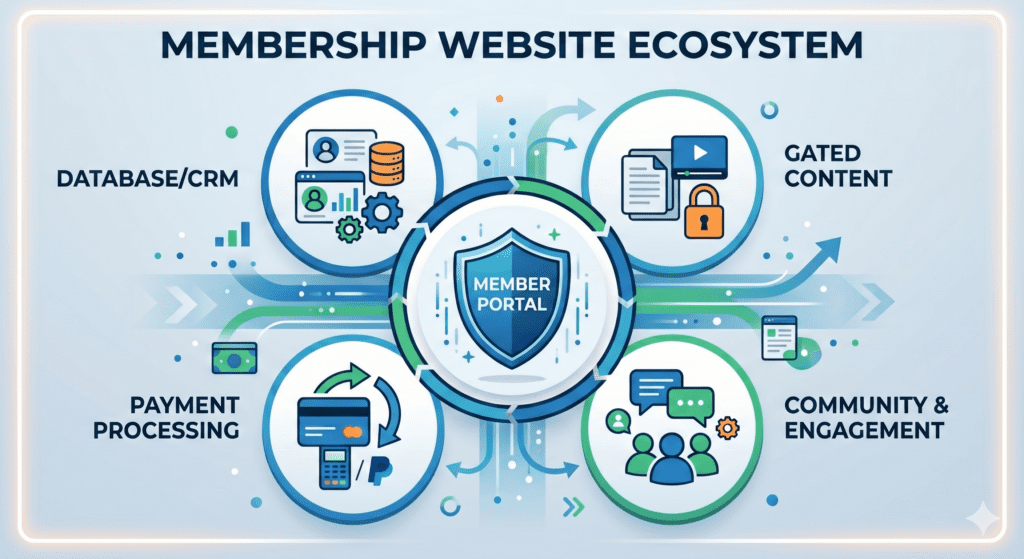
A membership website is a platform that gates content, manages a member database, and processes recurring payments through a single interface. Members sign up, choose a plan, and get access to restricted material. The site controls who can see what based on their subscription status. Common gated features include:
- Members-only articles, videos, or resource libraries
- Private discussion forums or community boards
- Event calendars with member-only registration
- Digital membership cards for check-in and verification
- Member directories and networking tools
Think of the website as your hardest-working staff member: it handles registration, chases failed payments, gates content, and sends renewal reminders while you focus on your community. Memberships with a dedicated community area see a 6% churn rate, compared to over 10% for those without one (Uscreen/Membership Geeks). That gap makes the platform choice matter. You want a system that supports engagement, not just content delivery.
3 Decisions Before You Start
Before you pick a tool or write a single page, you need to answer three questions. Every other decision flows from these.
Choose Your Platform Type
There are three main approaches to building a membership website. Each involves different trade-offs in cost, flexibility, and technical skill.
| Approach | Cost range (annual) | Technical skill | Best for |
|---|---|---|---|
| All-in-one platform (Raklet, Mighty Networks, Wild Apricot) | $0–$2,400+ | Low (no coding needed) | Associations, clubs, nonprofits that want to launch fast without managing hosting or plugins |
| WordPress + membership plugin (MemberPress at $179/yr, Paid Memberships Pro) | $300–$1,200+ | Medium (WordPress admin, plugin configuration, hosting management) | Organizations that already run WordPress and want full control over design and data |
| Custom-built (Rails, Django, Node.js with Stripe) | $5,000–$50,000+ | High (requires a developer) | Large organizations with unique workflows that no off-the-shelf product supports |
Most organizations should start with an all-in-one platform or WordPress. Custom builds make sense only when you have confirmed that existing platforms cannot handle a specific requirement. We regularly hear from organizations that started with a WordPress plugin stack and switched after a plugin update broke their payment gateway on renewal day. Membership management software like Raklet combines website building with CRM, event management, and payment processing in one system, which eliminates that plugin-juggling problem entirely.
Define Your Membership Tiers and Pricing
Membership pricing affects both revenue and retention. Before building anything, decide:
- How many tiers? Most organizations do well with 2–3 tiers (for example: Basic, Professional, Premium). More than four tiers creates decision fatigue for members.
- Monthly or annual billing? Annual plans improve cash flow and retention. Consider offering a 10–20% discount for annual commitments.
- What is gated at each level? Map specific content, events, or features to each tier. Members should understand exactly what they get at each price point.
- Free tier or free trial? A limited free tier works well for organizations that benefit from a large community base. A time-limited trial works better when your value proposition takes time to demonstrate.
If you are unsure about pricing, start with a lower price and increase it as you add value. It is easier to raise prices on new members than to lower them for existing ones. Review Raklet’s pricing page for an example of how tiered membership pricing is structured in practice.
Plan Your Content Strategy
Not everything should be behind the paywall. The most effective membership websites use a deliberate split between public and members-only content.
Public content is your discovery engine. Blog posts, introductory guides, event announcements, and preview pages attract organic search traffic and build trust with prospective members. Public content answers the questions people type into Google. When it is good enough, those visitors convert into members.
Gated content is the value members pay for. The most common gating pattern shows the title and a preview image of each piece of content publicly, but locks the body behind a membership wall. Visitors can browse the library and see what is available, but clicking through to read, watch, or download requires joining and paying. This approach works because it:
- Shows prospective members exactly what they will get before they pay
- Creates a growing catalog that becomes more valuable over time
- Keeps your gated content indexed by search engines (titles and descriptions are still public)
- Reduces friction because the “Join to access” prompt appears at the moment of highest interest
For gated material, focus on resources that deliver clear, immediate value:
- Templates, toolkits, and downloadable resources
- Recorded workshops, webinars, and training sessions
- Member directories and networking tools
- Certification and continuing education materials
- Private forums and community discussion boards
You do not need a full content library before launching. Start with 3–5 strong pieces of gated content and a clear publishing schedule. We have seen organizations delay their launch for months trying to build a “complete” library, only to discover that members mostly use two or three resources anyway. Consistency matters more than volume.
Use AI Tools to Speed Up the Build
AI tools can cut weeks off the process of building and running a membership website. You do not need to be technical to use them, and most work through plain-language prompts.
- Content creation. Use ChatGPT, Claude, or Gemini to draft gated content like guides, templates, and email sequences. A well-prompted AI can produce a first draft of a 2,000-word members-only guide in minutes. You still need to edit for accuracy and voice, but it eliminates the blank-page problem.
- Website building. AI website builders like Durable, 10Web, and Wix ADI generate full site layouts from a short description of your organization. These work best for simple membership sites. For complex setups with multiple tiers and gated areas, an all-in-one platform with built-in AI features is more practical.
- Member support. AI chatbots (Intercom, Tidio, or the built-in options on platforms like Raklet) can answer common member questions 24/7 (login issues, billing questions, event details) without staff involvement.
- Onboarding and personalization. AI can power personalized welcome sequences that adapt based on which tier a member joined, what content they browse, and how they found your site. This kind of automated personalization used to require custom development; now it is built into many membership platforms.
One important caveat: AI is good at producing first drafts, not at making the strategic decisions above. Decide your tiers, pricing, and content strategy yourself, then hand the execution work to AI.
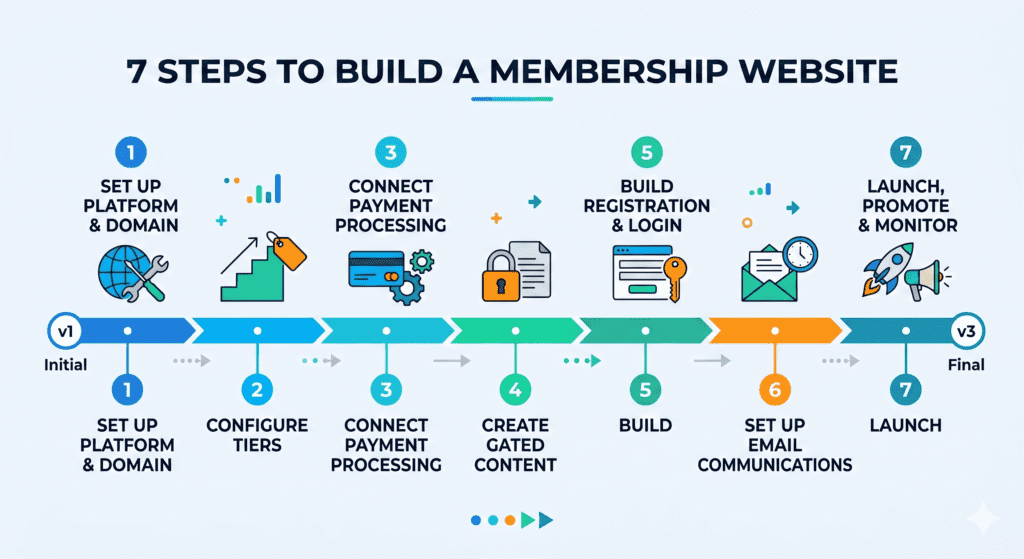
How to Build a Membership Website in 7 Steps
Step 1: Set Up Your Platform and Domain
Register a domain name that matches your organization’s name or mission. If you are using an all-in-one platform, this is usually part of the setup process. For WordPress, you will need separate hosting (Bluehost, SiteGround, or Kinsta are common choices).
Configure your site’s basic structure: homepage, about page, membership sign-up page, and a contact page. Most platforms provide templates you can customize without writing code.
Step 2: Configure Membership Tiers
Set up the tiers you planned in the decisions phase. For each tier, define:
- The name and description
- The price and billing cycle (monthly, annual, or both)
- Which content, features, or areas each tier can access
- Any trial period or introductory pricing
Keep the tier names simple and descriptive. “Professional Membership” is clearer than “Gold Tier.”
Step 3: Connect Payment Processing
Your membership website needs to accept recurring payments. Most platforms integrate with Stripe, PayPal, or both. Check that your payment setup handles:
- Automatic recurring billing
- Failed payment retries
- Upgrade and downgrade between tiers
- Invoicing and tax compliance for your jurisdiction
- Refund processing
Test the full payment flow yourself before launching. Sign up as a member, make a payment, access gated content, and cancel. Every step should work without confusion.
Step 4: Create Your Members-Only Content
Build out the content and resources for each membership tier. This could include:
- A resource library with downloadable files (templates, checklists, guides)
- Recorded webinars or training sessions
- A member directory with profile pages
- A digital membership card for event check-in or identity verification
- Private discussion areas or community boards
Prioritize the content that delivers the most immediate value. You can always add more after launch based on what members actually request.
Pro tip: Do not accidentally gate your “About Us,” “Contact,” or support pages. We see this surprisingly often. New members who cannot find the help page because it is locked behind a tier they have not activated yet will not stick around to figure it out.
Step 5: Build Registration and Login Forms
Your registration form is the front door. Keep it short: name, email, and payment information is usually enough for the initial sign-up. You can collect additional profile information after they have joined.
Make sure the login experience is straightforward. Members who cannot find the login page or who hit errors during sign-in will not renew. This sounds minor, but login friction is one of the top reasons members contact support in the first month. Include password reset functionality and consider enabling social login (Google, Apple) to reduce that friction.
Step 6: Set Up Email Communications
Automated emails keep members engaged and reduce churn. At minimum, set up:
- Welcome email: sent immediately after sign-up with login instructions and a quick-start guide
- Onboarding sequence: 3–5 emails over the first two weeks highlighting key features and content. The first seven days determine long-term engagement (iMIS 2026 Benchmark Report).
- Renewal reminders: sent 30, 7, and 1 day before a membership expires
- Re-engagement emails: for members who have not logged in for 30+ days
Step 7: Launch, Promote, and Monitor
Before launch, run through a pre-launch checklist:
- Test every payment flow and email trigger
- Verify mobile responsiveness (over 60% of membership traffic comes from mobile devices)
- Confirm that gated content is actually gated (log out and try to access it)
- Check page load speed, especially for image-heavy resource libraries
For promotion, start with your existing audience: email list, social media followers, event attendees. Offer an early-bird discount or founding member pricing to build initial momentum. After launch, track three numbers weekly: new member sign-ups, login frequency, and churn rate. These tell you whether your content and community are delivering enough value to retain members.
Membership Websites by Organization Type
The steps above apply broadly, but the specific implementation varies by organization type. Here is what matters most for each:
Associations and Professional Organizations
Associations typically need member directories, committee management, continuing education tracking, and event registration. The membership website often serves as the central hub for professional development and networking.
Key considerations: certification and credential tracking, chapter or regional group management, and integration with accounting systems for dues processing. Association management software is designed specifically for these workflows.
Nonprofits
Nonprofit membership websites serve dual purposes: engaging existing supporters and converting new donors. The membership model provides predictable recurring revenue that many nonprofits lack.
Key considerations: donation integration alongside membership fees, volunteer coordination tools, grant reporting on member engagement, and tax-deductible receipt generation. Look for platforms that handle both nonprofit management and membership in one system.
Clubs and Social Organizations
Clubs prioritize community interaction and event participation over content consumption. The membership website is more about coordination and belonging than gated content.
Key considerations: event RSVP and calendar management, photo and media sharing, member-to-member messaging, and sub-group management (for example, committees or interest groups). Club management software provides these features without the complexity of association-grade tools.
Gyms and Fitness Communities
Gym membership websites need tight integration between online access and physical facility management: class scheduling, check-in systems, and capacity management.
Key considerations: class booking and waitlist management, QR or digital card check-in at the door, trainer scheduling, and freeze or hold options for seasonal members. Gym management software handles the online-to-physical bridge that generic membership platforms often miss.
Example Walkthrough: Building a Membership Website With Raklet
The steps above apply to any platform. To make them concrete, here is what the process looks like on Raklet, from sign-up to a live membership site.
1. Create Your Organization and Choose a Plan
Sign up at raklet.com and create your organization. The free plan supports up to 50 members with core features (website builder, CRM, email). If you need custom domains, advanced analytics, or white-label branding, select a paid plan from the pricing page. You can start free and upgrade later without losing data.
2. Set Up Membership Plans and Pricing
Go to Settings → Membership Plans and create your tiers. For each plan, set the name, price, billing cycle (monthly, annual, or one-time), and a description of what is included. Raklet handles Stripe and PayPal integration directly. Connect your payment account under Settings → Payment Gateways and recurring billing is automatic.
3. Build Your Pages and Content Areas
Use the drag-and-drop website builder to create your homepage, about page, and any public-facing content. For members-only material, create posts or pages and set their visibility to specific membership plans. Raklet’s content gating works at the post level, so you choose which plans can see each piece of content, so free members see different material than premium members.
4. Configure the Member Directory and Profiles
Enable the member directory under Settings → Directory. Members get profile pages automatically when they join. You can add custom profile fields (job title, company, location, interests) to make the directory useful for networking. Control which fields are visible to other members versus admins only.
5. Set Up Automated Emails and Communications
Raklet includes built-in email tools. Set up your welcome email, renewal reminders, and re-engagement sequences under Communications. You can also send targeted emails to specific membership tiers. For example, you can notify premium members about an exclusive event without emailing your entire list.
6. Connect Your Domain and Launch
Point your custom domain to Raklet (paid plans) or use the default subdomain to launch immediately. Before going live, test the full member journey: sign up for each tier, make a test payment, access gated content, and check that automated emails fire correctly. Once everything works, announce the site to your existing contacts and start promoting.
FAQs About Building a Membership Website
How much does it cost to build a membership website?
Costs range widely by approach. An all-in-one platform like Raklet starts with a free plan and scales to $2,400+ per year for larger organizations. WordPress with a membership plugin like MemberPress costs around $300–$500 per year (hosting + plugin license). Custom-built solutions start at $5,000 and can exceed $50,000 depending on complexity.
What should be included in a membership website?
At minimum: a registration and login system, payment processing for recurring billing, gated content areas, a member profile page, and email communication tools. Most organizations also benefit from a member directory, event management, and community discussion features.
How do I choose between an all-in-one platform and WordPress?
If you want full control over every design detail and already have WordPress experience, go with WordPress and a membership plugin. If you want to launch quickly without managing hosting, updates, or plugin compatibility, use an all-in-one platform. Organizations without a dedicated web administrator typically save time with all-in-one solutions.
How do I retain members after they sign up?
Focus on the first seven days. Send a welcome email immediately, follow up with an onboarding sequence, and make it easy to find the most valuable content or community areas. Memberships with active community features see nearly half the churn rate of those without. Regular communication, fresh content, and member events all contribute to long-term retention.
Can I migrate my existing members to a new membership platform?
Yes. Most membership platforms support CSV import for member data. Payment migration is more complex. If you are switching payment processors, you may need members to re-enter payment information. Plan the migration during a low-activity period and communicate the change to members in advance.
What about data privacy and GDPR compliance?
Any membership site that collects personal data (names, emails, payment info) needs to comply with data protection regulations. At minimum, publish a clear privacy policy, use HTTPS, and ensure your payment processor is PCI-compliant. If you have members in the EU, you also need GDPR-compliant consent flows, full data portability (members can export their own data), and the ability to delete member records on request. Before choosing a platform, confirm it supports data export in a standard format like CSV. Most all-in-one platforms handle the technical compliance (encryption, secure storage) out of the box, but you are still responsible for your own privacy policy and consent language.
Do I need a lot of content before launching?
No. Start with 3–5 strong pieces of gated content and a clear plan for what you will publish next. A resource library, a member directory, and a community forum are often enough for launch. Consistency and responsiveness matter more than volume. Members stay for ongoing value, not a backlog they will never read.
Can I use AI tools to build a membership website?
Yes. AI tools can accelerate several parts of the process. Use ChatGPT, Claude, or Gemini to draft gated content like guides and email sequences. AI website builders like Durable and 10Web can generate initial site layouts. AI chatbots can handle routine member support. However, the strategic decisions (pricing, tiers, content strategy) still require human judgment.
Start Building Your Membership Website
Raklet provides membership management software that combines website building, CRM, payment processing, event management, and community tools in one platform. Over 4,000 organizations use Raklet to manage their membership operations.
Explore Raklet’s features to see what is included, or review the pricing plans to find the right fit for your organization.